PI DAY SOLAR WIND STREAM: A stream of solar wind flowing from a wide gash in the sun's atmosphere is approaching Earth. Estimated time of arrival: March 14 (3.14). Arctic sky watchers should be alert for auroras on Pi Day. Free: Aurora Alerts

EQUINOX CRACKS IN EARTH'S MAGNETIC FIELD: The vernal equinox is less than 10 days away. That means one thing: Cracks are opening in Earth's magnetic field. Researchers have long known that during weeks around equinoxes fissures form in Earth's magnetosphere. Solar wind can pour through the gaps to fuel bright displays of Arctic lights. One such episode occurred on March 9th. "The sky exploded with auroras," reports Kristin Berg, who sends this picture from Tromsø, Norway:

During the display, a stream of solar wind was barely grazing Earth's magnetic field. At this time of year, that's all it takes. Even a gentle gust of solar wind can breach our planet's magnetic defenses.
This is called the the "Russell-McPherron effect," named after the researchers who first explained it. The cracks are opened by the solar wind itself. South-pointing magnetic fields inside the solar wind oppose Earth's north-pointing magnetic field. The two, N vs. S, partially cancel one another, weakening our planet's magnetic defenses. This cancellation can happen at any time of year, but it happens with greatest effect around the equinoxes. Indeed, a 75-year study shows that March is the most geomagnetically active month of the year, followed closely by September-October--a direct result of "equinox cracks."
NASA and European spacecraft have been detecting these cracks for years. Small ones are about the size of California, and many are wider than the entire planet. While the cracks are open, magnetic fields on Earth are connected to those on the sun. Theoretically, it would be possible to pick a magnetic field line on terra firma and follow it all the way back to the solar surface. There's no danger to people on Earth, however, because our atmosphere protects us, intercepting the rain of particles. The afterglow of this shielding action is called the "aurora borealis."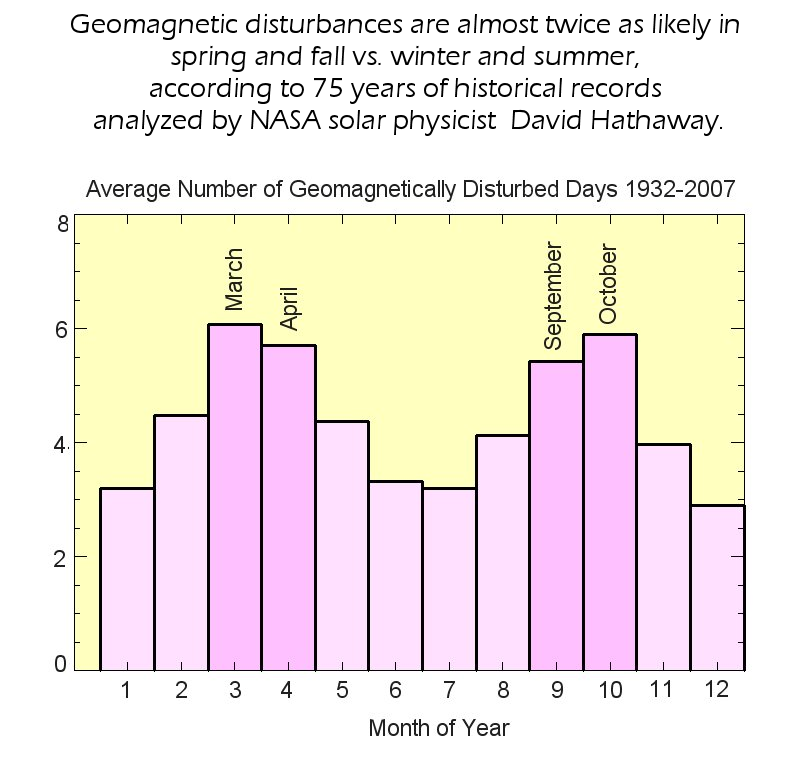
Stay tuned for more Arctic lights as spring approaches.
GET READY FOR MOTHER'S DAY: Are you looking for a far-out Mother's Day gift? Consider this: On March 5, 2018, the students of Earth to Sky Calculus flew a cosmic ray balloon to the stratosphere, more than 94,000 feet above Earth's surface. This pendant went along for the ride:

The students are selling these pendants as a fund-raiser for their cosmic ray monitoring program. You can have one for $99.95. Each pendant comes with a greeting card showing the jewelry in flight and telling the story of its journey to the stratosphere and back again. Mom-satisfaction guaranteed!
Far Out Gifts: Earth to Sky Store
All proceeds support hands-on STEM education
THE SUN IS BLANK: Sunspots are becoming scarce. So far in 2018, the sun has been blank--that is, without sunspots--for 36 days. That's more than half of the time. Inspect the face of today's sun:

Could you find any dark cores? Answer: No. The last time the sun was blank more than 50% of the time was in 2009, near the end of the deepest Solar Minimum of the Space Age. Now the sun is entering a new Solar Minimum, and it is shaping up to be even deeper than before.

Periods of spotlessness are a normal part of the 11-year solar cycle. However, the current Solar Minimum may be remarkable as the ambient solar wind and its magnetic field are weakening to low levels never before seen in the Space Age. The flagging pressure of the solar wind, in turn, is allowing more cosmic rays to penetrate the solar system. These rays are being detected not only by NASA spacecraft in the Earth-Moon system, but also by space weather balloons in Earth's atmosphere. Read "The Worsening Cosmic Ray Situation" to learn more about this phenomenon.