HAPPY PI DAY: March 14th (3.14) is  day, and all around the world pi-philes are celebrating one of the most compelling and mysterious constants of Nature. Pi appears in equations describing the orbits of planets, the colors of auroras, the structure of DNA. The value of is woven into the fabric of life, the universe and ... everything.
Humans have struggled to calculate for thousands of years. Divide the circumference of a circle by its diameter; the ratio is . Sounds simple, but the devil is in the digits. While the value of is finite (a smidgen more than 3), the decimal number is infinitely long:
3.1415926535897932384626433832795
02884197169399375105820974944592307
81640628620899862803482534211706...more
Supercomputers have succeeded in calculating more than 2700 billion digits and they're still crunching. The weirdest way to compute : throw toothpicks at a table or frozen hot dogs on the floor. Party time.
A GASH IN THE SUN'S ATMOSPHERE: A canyon-like hole has opened in the sun's atmosphere, and it is spewing a broad stream of solar wind toward Earth. NASA's Solar Dynamics Observatory is monitoring the structure, shown here on March 13th:

This is a "coronal hole"--a region where the sun's magnetic field opens up and allows solar wind to escape. Coronal holes appear, in various shapes and forms, several times each month. This one is unusually wide, stretching more than 800,000 km across the face of the sun.
NOAA forecasters say there is a 55% chance of G1-class geomagnetic storms when the solar wind stream arrives on March 14th or 15th. G1-class storms are relatively minor and have little effect on satellites and global power grids. However, they can disorient animals that migrate using magnetic cues at high latitudes and usually spark bright auroras around the Arctic Circle. Free: Aurora Alerts

Realtime Space Weather Photo Gallery
WILD RIDE OF THE EASTERNAUTS: Easter is coming early this year: April 1, 2018--hence the flight of the Easternauts. To support their cosmic ray ballooning program, the students of Earth to Sky Calculus have launched a payload full of bunnies to the edge of space:
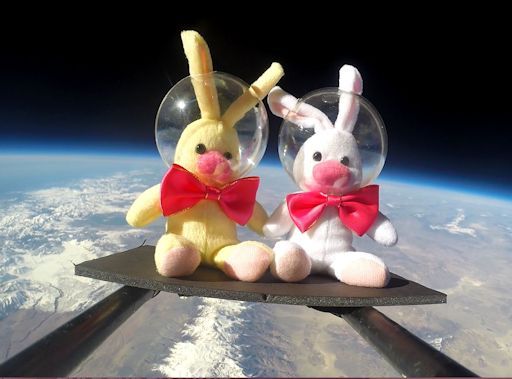
You can have one for $49.95. (Space helmet included!) They make great Easter gifts for young scientists, and all proceeds support STEM education. Each bunny comes with a greeting card showing the Easternaut in flight and telling the story of its journey to the stratosphere and back again.
Far Out Gifts: Earth to Sky Store
All proceeds support hands-on STEM education
POLLEN CORONA: It begins with a sneeze. Pollen floating through the air tickles your nose, and your body responds by expelling the allergen. Gesundheit! When the paroxysm subsides, look up at the sky. The same pollen that makes you sneeze can also make colorful coronas around the sun, like this one photographed on March 12th by Monika Landy-Gyebnar of Veszprem, Hungary:
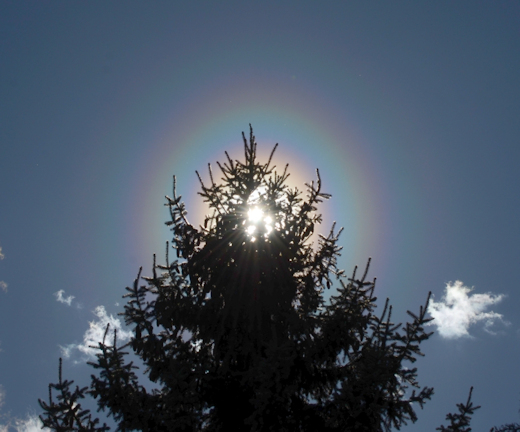
"As spring approaches, many of our local trees are beginning to bloom--including hazel, alder, willow and birch," says Landy-Gyebnar. "The day was warm and windy, which always helps the pollens get suspended in the air."
Coronas are rings of light produced by sunlight scattering from the outsides of small particles--in this case, pollens. Tiny droplets of water in clouds can make coronas, too, but pollen grains do even better. They make small but very colorful rings of light.
Unlike water droplets, pollens are non-spherical--and this adds to their magic. Many pollens have air sacs to help carry them in the wind. These align the grains so that their coronas are elliptical. This effect may be seen in Landy-Gyebnar's coronas, which are taller than they are wide.