SUNSET PLANETS: When the sun goes down tonight, step outside and look west. If you have a clear view of the horizon, you'll see Venus and Mercury beaming together through the twilight. On March 18th, the slender crescent Moon will join them, forming a beautiful 3-way conjunction. Enjoy the show! [sky map]

AURORAS DON'T NEED SUNSPOTS: On March 16th, the sun was blank (No sunspots) and NOAA classified solar activity as "very low." Nevertheless, this happened:

"The auroras were really strong early in the afternoon even before we had proper darkness here at 69N in Tromsø, Norway," reports photographer Ole C. Salomonsen. "We know we are heading towards solar minimum, with fewer spots and flares on the sun, but still I have to say this has been a very good season with strong auroras. We know that equinoxes are particularly active. Once again, this was proven to me."

He's right. Auroras don't need sunspots. The display was caused by a stream of solar wind flowing from a wide gash in the sun's atmosphere--also known as a "coronal hole." Coronal holes form often during solar minimum, lashing Earth with streams of solar wind that spark beautiful Arctic lights. Free: Aurora Alerts

THESE PENDANTS HAVE TOUCHED SPACE: On Dec. 31, 2017, the students of Earth to Sky Calculus flew a payload full of heart-shaped pendants to the stratosphere. Here's one 115,158 feet above the Sierras of central California:
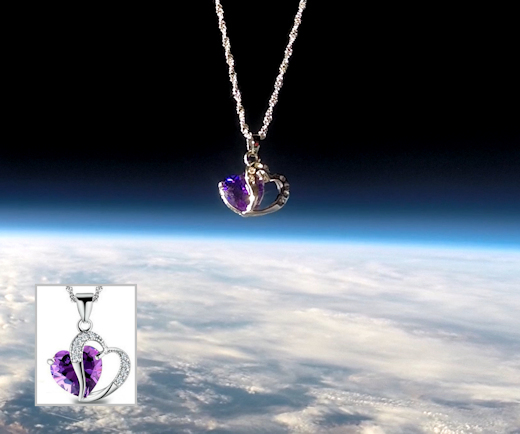
You can have one for $119.95. These jewels make great birthday and anniversary gifts. Each glittering pendant comes with a greeting card showing the jewelry in flight and telling the story of its journey to the edge of space. Sales of this pendant support the Earth to Sky Calculus cosmic ray ballooning program and hands-on STEM research.
Far Out Gifts: Earth to Sky Store
All proceeds support hands-on STEM education
MUST-SEE AURORA MOVIE: On March 14th, deep inside the Arctic Circle, photographer Oliver Wright stood outside in the cold waiting for the solar wind to arrive. Suddenly, the sky erupted in a swirling cauldron of color--"possibly the best I've ever seen," says Wright, who has been leading aurora tours for years in Abisko, Sweden. Turn up the volume and listen to the cries of delight in Wright's 3 minute video:
"My fingers got so cold taking this video," he says, "but it was worth it."
Watch the video again and pay special attention to the moments after 1:30. Those dynamic swirls of pink are caused by energetic particles reaching unusually deep into Earth's atmosphere, interacting with nitrogen molecules to produce a pink glow so intense that it sometimes appeared white.
This outburst was caused by a crack forming in Earth's magnetic field. Ambient solar wind (not the high-speed stream Wright was waiting for) poured in to fuel the display. Magnetic cracks occur more frequently than usual during weeks around equinoxes, which make this a great time of year for Arctic lights. Free: Aurora Alerts
