SPACE WEATHER FORECAST: NOAA forecasters say there is a 55% chance of G1-class geomagnetic storms on March 22nd when the solar wind currently blowing around Earth is expected to intensify. Arctic auroras are likely on the first nights of northern spring. Free: Aurora Alerts

SUNSET PLANETS: On March 18th, sky watchers around the world witnessed a beautiful conjunction of the crescent Moon, Venus and Mercury. Mauricio Labrador Garcia sends this picture from Tenerife on the Canary Islands:

"It was an unforgettable sunset in La Orotava Valley," says Garcia. "Almost at its maximum elongation, Mercury looked great above Venus and the new Moon"
Did you miss the display? Good news: There's another viewing next month. On April 17th, Mercury won't be present, but Venus and the crescent Moon will be even closer together in the sunset sky--a gorgeous pair. Moreover, the Moon's "ashen glow" will be very bright. Studies show that Earthshine is most intense during northern spring. Conjunctions of Venus and the crescent Moon with Earthshine are considered one of the most beautiful sights in the heavens, so mark your calendar and enjoy the show. [sky map]

Realtime Space Weather Photo Gallery
MAGNETIC CRACKS AND STORMS: For the past five days, Earth's magnetic field has been in a state of unrest as an unusually-wide stream of solar wind blows around our planet. Literally, the geomagnetic field has been shaking back and forth. This plot from Stuart Green's backyard magnetometer in Preston, UK, shows the unrest, highlighted by a G2-class geomagnetic storm on March 18th:

Blue squiggles in Green's chart represent changes in his local magnetic field caused by the buffeting of solar wind high overhead. "Magnetic activity has been relatively high since March 14th with several distinct periods of storminess," he says. "Magnetometers all around the world are registering this."
The speed and pressure of the solar wind are key factors in stirring up magnetic storms--but not the only factor. Even more important is the formation of cracks in Earth's magnetic field, which allow solar wind to penetrate. How do we know when cracks are forming? Green has prepared another plot to answer this question:
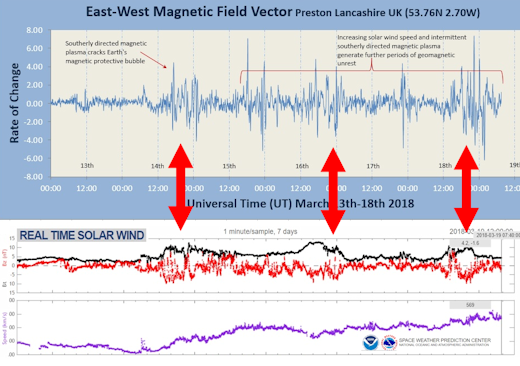
"I lined up NOAA solar wind data with my own magnetometer chart," he says. "Note the red curve in the solar wind data. Much of the magnetic unrest I've been recording correlates with negative Bz, when the magnetic field of the approaching solar wind tips south."
Indeed, that is exactly how cracks form. The magnetic field in the solar wind points south, partial cancelling Earth's north-pointing magnetic field. Solar wind pours in through the resulting weak point. These cracks tend to form most often during weeks around equinoxes--a phenomenon known as the "Russell-McPherron effect."
Note to auroraphiles: Keep an eye on Bz right here on Spaceweather.com. When it tips south (becomes negative), that is the best time to watch for Northern Lights.

THESE PENDANTS HAVE TOUCHED SPACE: On Dec. 31, 2017, the students of Earth to Sky Calculus flew a payload full of heart-shaped pendants to the stratosphere. Here's one 115,158 feet above the Sierras of central California:
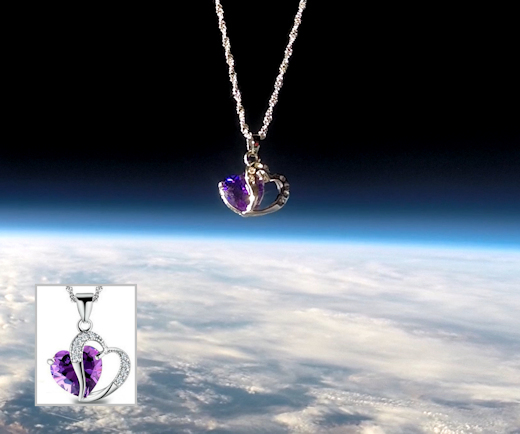
You can have one for $119.95. These jewels make great birthday and anniversary gifts. Each glittering pendant comes with a greeting card showing the jewelry in flight and telling the story of its journey to the edge of space. Sales of this pendant support the Earth to Sky Calculus cosmic ray ballooning program and hands-on STEM research.