CHANCE OF STORMS TODAY: NOAA forecasters estimate a 55% chance of G1-class geomagnetic storms today, March 25th, as a stream of solar wind blows around Earth. The gaseous material is flowing from a southern hole in the sun's atmosphere. Polar sky watchers should be alert for auroras. Free: Aurora Alerts


'TIS THE SEASON FOR 'STEVE': Last night, something happened at the edge of space over Alaska. More than 200 km above Anchorage, a hot ribbon of ionized gas snaked through Earth's magnetosphere, creating a luminous arc that rivaled the Moon in brightness. Sanjana Greenhill witnessed the apparition:

"We noticed this perfect arc developing across the sky," says Greenhill. "It didn't seem like the aurora since it wasn't moving much. The arc got brighter and then faded and then got brighter again. And then it dawned on me, this is STEVE!"
STEVE is an aurora-like phenomenon that researchers are only beginning to understand. For many years, northern sky watchers reported the form occasionally dancing alongside auroras. It was widely called a "proton arc" until researchers pointed out that protons had nothing to do with it. So members of the Alberta Aurora Chasers group gave it a new name: "Steve" (since upgraded to STEVE, an acronym for 'Strong Thermal Emission Velocity Enhancement.')
The first clues to the nature of STEVE came in 2016 when one of the European Space Agency's Swarm satellites encountered the phenomenon. "As the satellite flew straight though 'Steve,' the temperature jumped by 3000°C and the data revealed a 25 km-wide ribbon of gas flowing westwards at about 6 km/s (13,000 mph)," reports Eric Donovan from the University of Calgary.
This ESA animation shows Swarm satellites orbiting Earth above ground cameras observing STEVE
Donovan and a team of colleagues led by Elizabeth MacDonald of NASA's Goddard Space Flight Center have just published a paper on STEVE. In it, they confirm that STEVE is distinct from ordinary auroras, usually forming to the south of active Northern Lights. The mauve and purple colored arcs, they say, are related to supersonic rivers of gas called "subauroral ion drifts" (SAIDs), which flow through Earth's magnetic field. Earth-orbiting satelites have tracked thousands of SAIDs: they tend to appear near latitude +60 degrees, and occur more frequently during spring and fall than summer and winter.
This last point means that now is the season for STEVE. The onset of northern spring seems to lure the arc out of winter hiding.
"I saw STEVE for the first time on March 18th," reports Giuseppe Petricca , who took this sequence of pictures from the Isle of Lewis in Scotland:

"It was an ever-changing tornado, with violet tones, always in movement, always with different shapes," he says. "Another wonder of Nature!"
The mystery of STEVE is far from solved. Researchers still don't understand why STEVE is purple--or for that matter why the underlying rivers of gas should glow at all. "Further spectral analysis and modeling are needed," say MacDonald et al.
In other words, keep an eye out for STEVE.
Realtime "Steve" Photo Gallery
OUT OF THIS WORLD GIFT: It's sterling silver and it comes from space. On March 5, 2018, the students of Earth to Sky Calculus flew a cosmic ray balloon to the stratosphere, more than 94,000 feet above Earth's surface. This Mother's Day pendant went along for the ride:
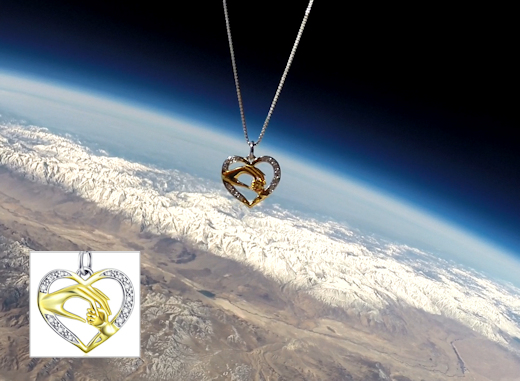
You can have one for $119.95. The students are selling these pendants as a fund-raiser for their cosmic ray monitoring program. All proceeds support atmospheric radiation measurements and hands-on STEM education.
Each pendant comes with a greeting card showing the jewelry in flight and telling the story of its journey to the stratosphere and back again. Mom-satisfaction guaranteed.
Far Out Gifts: Earth to Sky Store
All proceeds support hands-on STEM education