CHANCE OF STORMS: NOAA forecasters estimate a 45% chance of G1-class geomagnetic storms today, March 26th, as a stream of solar wind blows around Earth. The gaseous material is flowing from a southern hole in the sun's atmosphere. Polar sky watchers should remain alert for auroras. Free: Aurora Alerts


CHINA'S DOOMED SPACE STATION: China's Tiangong-1 space station is about to return to Earth--as a massive fireball. According to the European Space Agency (ESA), the 8-ton spacecraft will re-enter the atmosphere sometime between March 30th and April 2nd. Tiangong-1 is about the size of a European cargo spacecraft, such as the ATV-1 which itself re-entered in 2008. This re-entry video of the ATV-1 shows what the Tiangong-1 fireball might look like:
Tiangong-1 was launched in Sept. 2011 to establish a foothold in Earth orbit for China's fledgling space program. It served as a temporary home in space for two crews, including China's first female astronauts, and provided a testbed for automated rendezvous and docking procedures. China lost control of Tiangong-1 in 2016 when a telemetry link failed. This made it impossible for mission controllers to guide the station to a re-entry over the South Pacific Ocean as originally planned. Instead, Tiangong-1 would re-enter on its own schedule as aerodynamic friction with Earth's upper atmosphere slowly drained the station's orbital energy.
Initially, Chinese officials speculated that re-entry would occur in late 2017. However, low solar activity delayed the splashdown. Sunspot numbers have plummeted recently as the solar cycle heads toward a deep solar minimum:

Without sunspots, the sun's extreme ultraviolet radiation decreased. Earth's upper atmosphere cooled and contracted, reducing aerodynamic friction that would otherwise bring Tiangong-1 down. "Late 2017" became the spring of 2018.
At the moment it is impossible to predict exactly where Tiangong-1 will re-enter. All we know is that it will disintegrate somewhere between +42.8 and -42.8 degrees latitude, the upper and lower limits of the station's tilted orbit. This map from the ESA shows the re-entry zone:

Even with an uncontrolled re-entry, the odds strongly favor a descent over uninhabited land or ocean. According to the ESA, "[surviving fragments] will be scattered over a curved ellipsoid that is thousands of km in length and tens of km wide. The personal probability of being hit by a piece of debris from the Tiangong-1 is actually 10 million times smaller than the yearly chance of being hit by lightning."
In other words, don't worry. You'll be lucky just to see the fireball. Approximately one day before the reentry, it will become possible to roughly predict re-entry ground tracks, and hence which regions on Earth might witness the disintegration. Stay tuned for updates.
Realtime Space Weather Photo Gallery
THE LONGEST HOME RUN: Move over, Mickey Mantle. The students of Earth to Sky Calculus have just set a new home run record. According to the Guinness Book of World Records, Mantle hit a 565 foot blast on April 17, 1953. Eclipsing that mark, a Dodger ball launched by the students on March 17, 2018, sailed 700 times farther. The baseball traveled to the stratosphere on board a cosmic ray balloon:
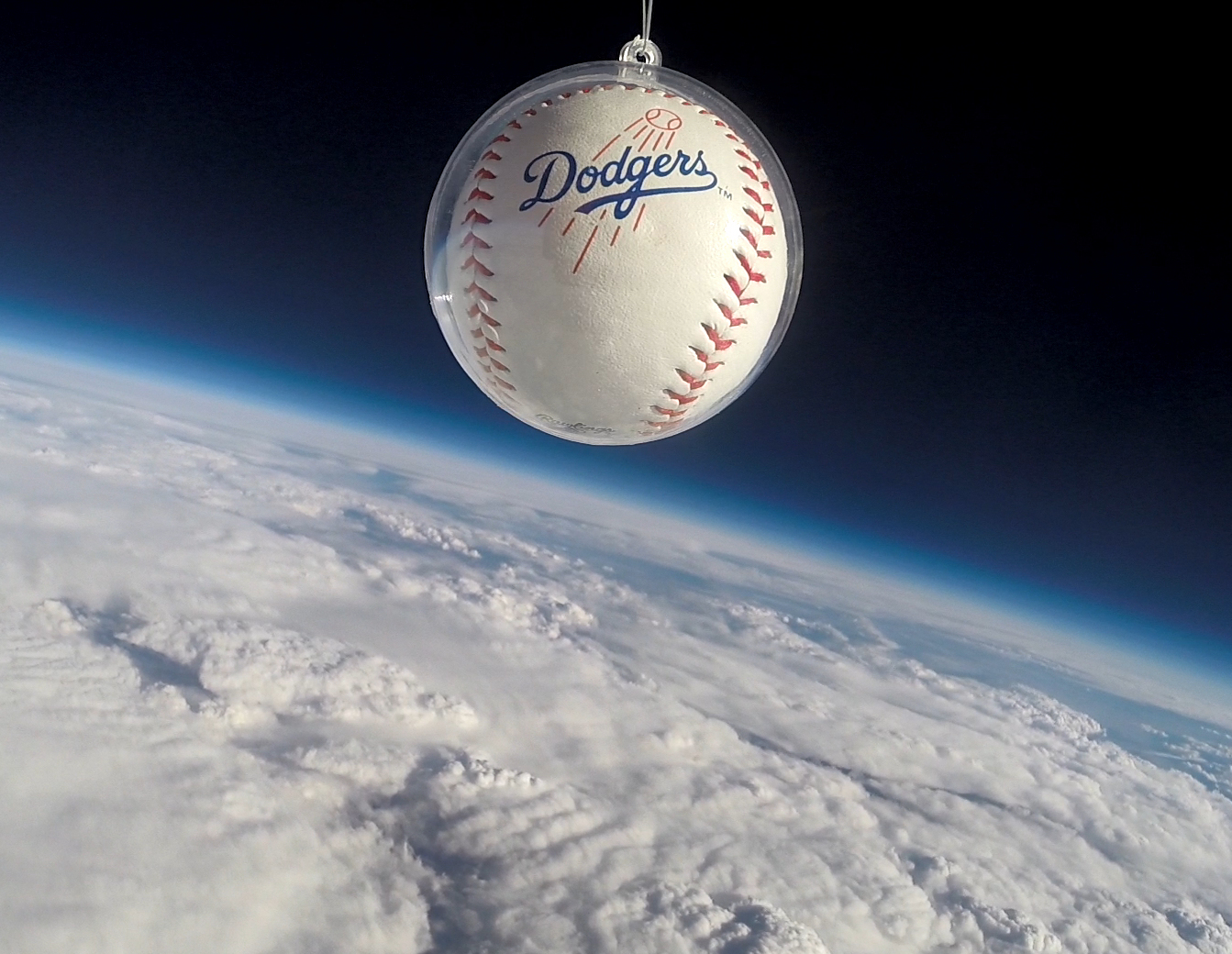
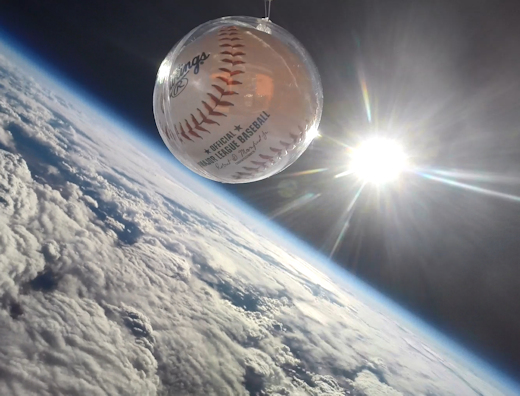
After the balloon exploded 35.4 km (116,000 ft) above the Sierra Nevada mountains of central California, the payload parachuted back to Earth, landing in the desert near Gemfield, NV, more than 123 km from the launch site. Now that's a homer!
The payload carried commemorative baseballs for the following teams: Dodgers, Cubs, Red Sox, Yankees, Padres, and Giants. You can have one for $139.95. During checkout, enter your preferred team in the COMMENTS section. We will send you the corresponding baseball. If your home team is not on the list, let us know and we will fly it for you on an upcoming flight.
Each baseball comes with a greeting card showing the ball in flight and telling the story of its journey to the stratosphere. They make great gifts for baseball fans, and all proceeds support STEM education.
Far Out Gifts: Earth to Sky Store
All proceeds support hands-on STEM education
STRANGE AURORA-LIKE ARC SIGHTED OVER ALASKA: On Saturday night, something happened at the edge of space over Alaska. More than 200 km above Anchorage, a hot ribbon of ionized gas sliced through Earth's magnetosphere, creating a luminous arc that rivaled the Moon in brightness. Sanjana Greenhill witnessed the apparition:

"We noticed this perfect arc developing across the sky," says Greenhill. "It didn't seem like the aurora since it wasn't moving much. The arc got brighter and then faded and then got brighter again. And then it dawned on me, this is STEVE!"
STEVE is an aurora-like phenomenon that researchers are only beginning to understand. For many years, northern sky watchers reported the form occasionally dancing alongside auroras. It was widely called a "proton arc" until researchers pointed out that protons had nothing to do with it. So members of the Alberta Aurora Chasers group gave it a new name: "Steve" (since upgraded to STEVE, an acronym for 'Strong Thermal Emission Velocity Enhancement').
The first clues to the nature of STEVE came in 2016 when one of the European Space Agency's Swarm satellites encountered the phenomenon. "As the satellite flew straight though 'Steve,' the temperature jumped by 3000°C and the data revealed a 25 km-wide ribbon of gas flowing westwards at about 6 km/s (13,000 mph)," reports Eric Donovan from the University of Calgary.
This ESA animation shows Swarm satellites orbiting Earth above ground cameras observing STEVE
Donovan and a team of colleagues led by Elizabeth MacDonald of NASA's Goddard Space Flight Center have just published a paper on STEVE. In it, they confirm that STEVE is distinct from ordinary auroras, usually forming to the south of active Northern Lights. The mauve and purple colored arcs, they say, are related to supersonic rivers of gas called "subauroral ion drifts" (SAIDs), which flow through Earth's magnetic field. Earth-orbiting satelites have tracked thousands of SAIDs: they tend to appear near latitude +60 degrees, and occur more frequently during spring and fall than summer and winter.
This last point means that now is the season for STEVE. The onset of northern spring seems to lure the arc out of winter hiding.
"I saw STEVE for the first time on March 18th," reports Giuseppe Petricca , who took this sequence of pictures from the Isle of Lewis in Scotland:

"It was an ever-changing tornado, with violet tones, always in movement, always with different shapes," he says. "Another wonder of Nature!"
The mystery of STEVE is far from solved. Researchers still don't understand why STEVE is purple--or for that matter why the underlying rivers of gas should glow at all. "Further spectral analysis and modeling are needed," say MacDonald et al.
In other words, keep an eye out for STEVE.
Realtime "Steve" Photo Gallery