GEOMAGNETIC ACTIVITY: Solar wind flowing from a northern hole in the sun's atmosphere is expected to reach Earth on March 30th. NOAA forecasters estimate a 40% chance of polar geomagnetic activity when the gaseous material arrives. Sky watchers around both poles should be alert for auroras mixed with moonlight. Free: Aurora Alerts

WHERE WILL CHINA'S SPACE STATION RE-ENTER? (UPDATED) Eight tons of Chinese space hardware are about to disintegrate in a bright fireball. The European Space Agency (ESA) says the Tiangong-1 space station will re-enter Earth's atmosphere sometime between the morning of 31 March and the afternoon of 1 April (in UTC time). The broad uncertainty in re-entry time makes it impossible to predict exactly where Tiangong-1 will re-enter. All we know is that it will disintegrate somewhere between +42.8 and -42.8 degrees latitude, the upper and lower limits of the station's tilted orbit:

Although most of Earth's population is contained within the possible re-entry zone, the odds strongly favor a descent over uninhabited land or ocean. According to the ESA, "[surviving fragments] will be scattered over a curved ellipsoid that is thousands of km in length and tens of km wide. The personal probability of being hit by a piece of debris from the Tiangong-1 is actually 10 million times smaller than the yearly chance of being hit by lightning."
Approximately one day before the reentry, it will become possible to roughly predict re-entry ground tracks, and hence which regions on Earth might witness the fireball. Stay tuned for updates.
LAST SIGHTINGS OF TIANGONG-1: In just a few days, China's Tiangong-1 space station will lie scattered across some unknown region of Earth, disintegrated by re-entry into the atmosphere. For now, though, it is still in orbit, and Maximilian Teodorescu took advantage of the little time remaining to take a unique picture of the doomed spacecraft. On March 28th, he photographed Tiangong-1 crossing in front of the sun over Bucharest, Romania:

"This is my first and last image of the Chinese space station," says Teodorescu. "I had no clouds for this event, but the altitude of the Sun was rather low (28 degrees) and together with some poor seeing, the silhouette of Tiangong 1 is barely discernible. Nevertheless, this is surely one of the last observation of the station before it enters the atmosphere."
Farewell Tiangong-1, and thanks for the parting shot! Visit Teodorescu's blog for more information about the equipment he used to capture the transit.
Realtime Space Weather Photo Gallery
MOTHER'S DAY IS ONLY 6 WEEKS AWAY: On March 5, 2018, the students of Earth to Sky Calculus flew a cosmic ray balloon to the stratosphere, more than 94,000 feet above Earth's surface. This sterling silver Mother's Day pendant went along for the ride:
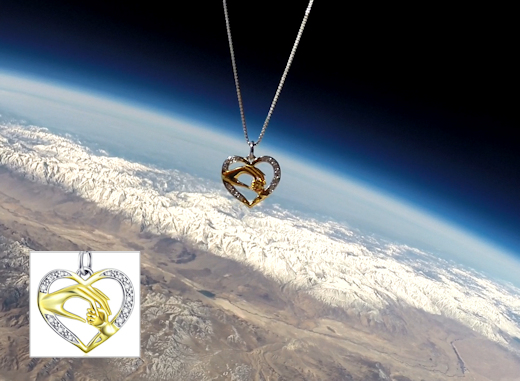
You can have it for $119.95. The students are selling these pendants as a fund-raiser for their cosmic ray monitoring program. All proceeds support atmospheric radiation measurements and hands-on STEM education.
Each pendant comes with a greeting card showing the jewelry in flight and telling the story of its journey to the stratosphere and back again. Mom-satisfaction guaranteed.
Far Out Gifts: Earth to Sky Store
All proceeds support hands-on STEM education