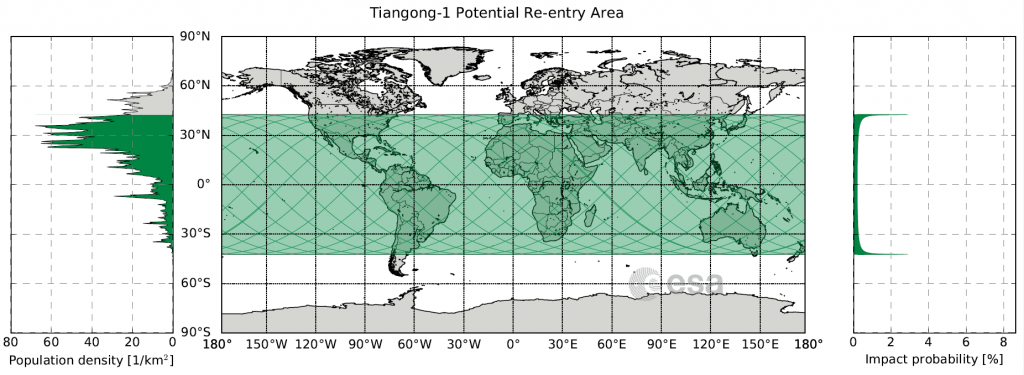
UPDATED RE-ENTRY PREDICTIONS: The uncertainty of Tiangong-1's re-entry time is narrowing. China's doomed space station will fall into the atmosphere on April 1st at 07:15 UTC ± 20 hours, according to the Aerospace Corporation. The precision of this forecast, however, is still not sufficient to pinpoint the location of the fireball. Tiangong-1 may re-enter almost anywhere on Earth between latitudes 43ºN and 43ºS (see map here). Stay tuned for updates.
LAST SIGHTINGS OF TIANGONG-1: In just a few days, China's Tiangong-1 space station will lie scattered across some unknown region of Earth, disintegrated by re-entry into the atmosphere. For now, though, it is still in orbit, and Maximilian Teodorescu took advantage of the little time remaining to take a unique picture of the doomed spacecraft. On March 28th, he photographed Tiangong-1 crossing in front of the sun over Bucharest, Romania:

"This is my first and last image of the Chinese space station," says Teodorescu. "I had no clouds for this event, but the altitude of the Sun was rather low (28 degrees) and together with some poor seeing, the silhouette of Tiangong 1 is barely discernible. Nevertheless, this is surely one of the last observation of the station before it enters the atmosphere."
Farewell Tiangong-1, and thanks for the parting shot! Visit Teodorescu's blog for more information about the equipment he used to capture the transit.
Realtime Space Weather Photo Gallery
MOTHER'S DAY IS ONLY 6 WEEKS AWAY: On March 5, 2018, the students of Earth to Sky Calculus flew a cosmic ray balloon to the stratosphere, more than 94,000 feet above Earth's surface. This sterling silver Mother's Day pendant went along for the ride:
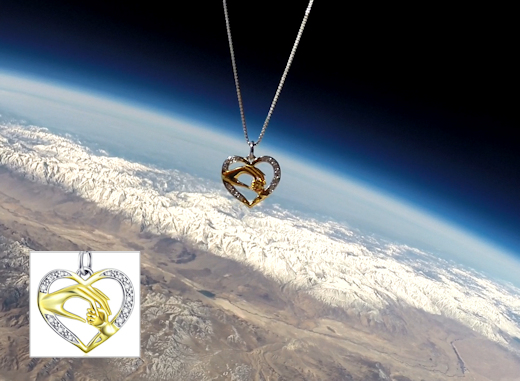
You can have it for $119.95. The students are selling these pendants as a fund-raiser for their cosmic ray monitoring program. All proceeds support atmospheric radiation measurements and hands-on STEM education.
Each pendant comes with a greeting card showing the jewelry in flight and telling the story of its journey to the stratosphere and back again. Mom-satisfaction guaranteed.
Far Out Gifts: Earth to Sky Store
All proceeds support hands-on STEM education
SOMETHING IN THE OFFING? The sun has been without sunspots almost every day this month--including today. This could soon change. The magnetic canopy of an active region is rising over the sun's eastern limb, shown here in a photo from NASA's Solar Dynamics Observatory:

The plume likely heralds the approach of a new sunspot. It's probably not a large one, though. As the sunspot cycle descends toward Solar Minimum--happening now!--sunspots tend to decrease in size and lose their potency. Amateur astronomers with backyard solar telescopes are encouraged to monitor the sun's eastern limb ... for whatever's coming. Free: Solar Flare Alerts
