SPACE WEATHER DELAYS THE RETURN OF TIANGONG-1: China's Tiangong-1 space station will remain in orbit a few hours longer than expected, according to the European Space Agency. Re-entry is now predicted to occur sometime between the night of March 31st and the late evening of April 1st (in UTC time).
"Today's forecast is a noticeable change from that of yesterday, and is due to solar activity," says the ESA Space Debris Office. "A high-speed stream of particles from the sun, which was expected to reach Earth and influence our planet's geomagnetic field on March 30th, did not, in fact, have any effect. This means that the density of the upper atmosphere, through which Tiangong-1 is moving, did not increase as predicted (which would have dragged the spacecraft down sooner)."

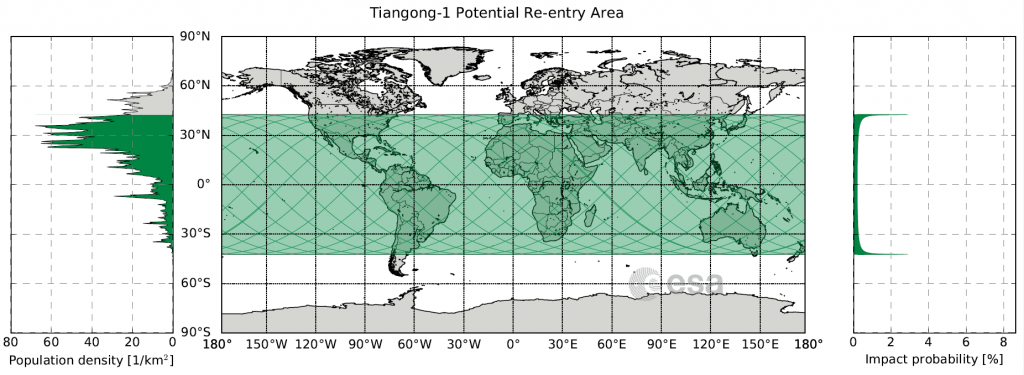
The precision of today's forecast, while improving, is still not sufficient to pinpoint the location of the fireball. Tiangong-1 may re-enter almost anywhere on Earth between latitudes 43ºN and 43ºS: map. Stay tuned for updates as the doomed spacecraft sinks deeper into the atmosphere.
MOTHER'S DAY IS ONLY 6 WEEKS AWAY:On March 5, 2018, the students of Earth to Sky Calculus flew a cosmic ray balloon to the stratosphere, more than 94,000 feet above Earth's surface. This sterling silver Mother's Day pendant went along for the ride:
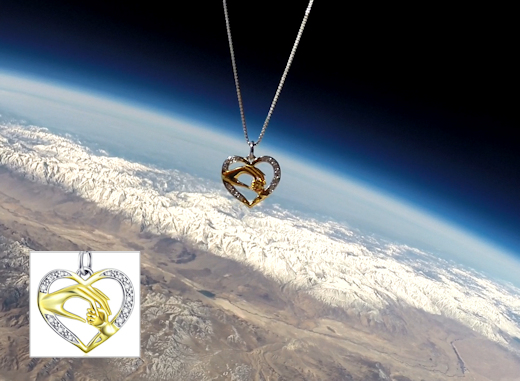
You can have it for $119.95. The students are selling these pendants as a fund-raiser for their cosmic ray monitoring program. All proceeds support atmospheric radiation measurements and hands-on STEM education.
Each pendant comes with a greeting card showing the jewelry in flight and telling the story of its journey to the stratosphere and back again. Mom-satisfaction guaranteed.
Far Out Gifts: Earth to Sky Store
All proceeds support hands-on STEM education
RARE SOLAR MINIMUM SUNSPOT: Almost every day this month, the face of the sun has been utterly blank. Today, however, a new sunspot is growing near the sun's southeastern limb, pocking the surface of our star with several Moon-sized dark cores. This movie from NASA's Solar Dynamics Observatory shows sunspot genesis in action:

Only on the eve of Solar Minimum would such a puny sunspot attact attention--and that is exactly where we are. Sunspot numbers are plummeting toward a deep nadir of the solar cycle expected to hit bottom in 2019-2020. For the foreseeable future, every sunspot is a rarity worthy of note.

This sunspot will probably remain small and quiet. But we could be wrong. Occasionally, potent sunspots emerge during Solar Minimum, unleashing powerful flares. Astronomers with backyard solar telescopes are encouraged to monitor this one ... just in case.
Realtime Space Weather Photo Gallery