A HOLE IN THE SUN'S ATMOSPHERE: A wide gash in the sun's atmosphere is spewing solar wind toward Earth. Estimated time of arrival: April 9th. G1-class geomagnetic storms are possible when the gaseous material reaches our planet. Free: Aurora Alerts.


THE GREAT WALL OF PLASMA: Around the world, amateur astronomers are monitoring a wall of hot plasma rising up from the sun's southeastern limb. This shot comes from Barry Riu at the Deerlick Astronomy Village in Georgia:

The structure is more than 40,000 km high. In other words, you could balance three Earths, on one top of another, and the stack would still not reach over the top of this fiery barrier.
"These dimensions made it an easy target for my 4.5 inch refractor with a Daystar solar filter," says Riu. Images from other observatories show that the prominence is changing rapidly with time. Monitoring is encouraged!
Realtime Space Weather Photo Gallery
THE DOG STAR AND ITS PUP: When the sun goes down at this time of year, the first star to pop out of the deepening twilight is Sirius. The Dog Star is almost twice as massive and 26 times more luminous than our sun. We've all seen it. But have you ever seen the Dog Star's pup? "I've been trying to find the pup for more than 6 years," says Peter Rosén of Stockholm, Sweden. "Finally, on March 28th, I did it!" It's circled red in this close-up image of Sirius (inset):

The pup is Sirius's white dwarf companion. Discovered in 1862, the extremely dense star packs the mass of our sun into a sphere about the size of Earth. It is 10,000 times fainter than Sirius and orbits the "big dog" at about the same distance as Uranus orbits the sun. No wonder it is so hard to find.
"I got a superb instrument on loan last week, a hand polished Maksutov OMC-200 from Orion Optics UK," says Rosén. "I adapted an ADC (atmospheric Dispersion Corrector) and successfully split the 2 stars at an altitude of only 8° above the horizon on my first attempt. In the illustration of the pup's orbit around Sirius, I put a red dot at the pup's measured position and was very pleased to confirm that it was almost spot on."
Now is a good time to see the pup as it travels around its elliptical orbit near maximum separation from Sirius for the next few years. With steady seeing and a clear atmosphere, it is possible to split the pair using telescopes as small as 6 inches. Rosén's video shows what to expect when you bend over the eyepiece.

Realtime Space Weather Photo Gallery
MOTHER'S DAY IS ONLY 5 WEEKS AWAY: Nothing says "I Love You" like a heart-shaped pendant from the edge of space. On March 17, 2018, the students of Earth to Sky Calculus flew an array of cosmic ray sensors to the stratosphere onboard a giant helium balloon. This pendant went along for the ride:
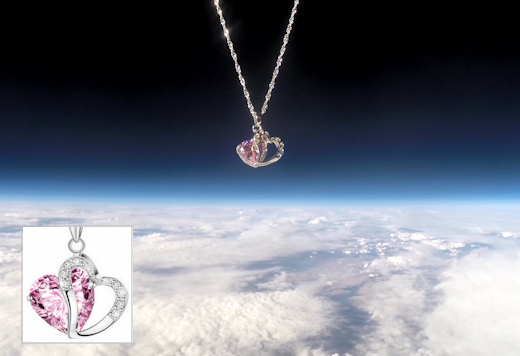
You can have it for $99.95. The students are selling these pendants as a fund-raiser for their cosmic ray monitoring program--and they make great Mother's Day gifts. All proceeds support atmospheric radiation measurements and hands-on STEM education.
Each pendant comes with a greeting card showing the jewelry in flight and telling the story of its journey to the stratosphere and back again. Mom-satisfaction guaranteed.
Far Out Gifts: Earth to Sky Store
All proceeds support hands-on STEM education
Realtime Space Weather Photo Gallery