CAN BIRDS SEE SPACE WEATHER? Researchers have long suspected that birds can see magnetic fields. Now, two new studies have identified a specific protein that gives birds this uncanny sense. Both single out Cry4, a light-sensitive protein found in the retinas of zebra finches and European robins. This raises the interesting possibility that birds can see geomagnetic storms--not only by watching auroras as humans do, but also by witnessing the underlying unrest of Earth's magnetic field. Learn more about the research from ScienceNews.
A HOLE IN THE SUN'S ATMOSPHERE: A wide hole in the sun's atmosphere is facing Earth and spewing a stream of solar wind toward our planet. Estimated time of arrival: April 9th. In this extreme ultraviolet image from NASA's Solar Dynamics Observatory, we see not only the hole, but also a bushy filament of magnetic bordering the hole's leading edge:

Such filaments are often unstable. If this one erupts while it is facing Earth, it could hurl a CME in our direction, adding to the effect of the incoming solar wind.
The canyon-shaped hole is remarkably wide, stretching more than 700,000 km from end to end. As a result, Earth could be under the influence of its gaseous emissions for days. Polar geomagnetic unrest and minor G1-class magnetic storms are possible from April 9th through 13th. Free: Aurora Alerts.

MOTHER'S DAY IS ONLY 5 WEEKS AWAY: Nothing says "I Love You" like a heart-shaped pendant from the edge of space. On March 17, 2018, the students of Earth to Sky Calculus flew an array of cosmic ray sensors to the stratosphere onboard a giant helium balloon. This pendant went along for the ride:
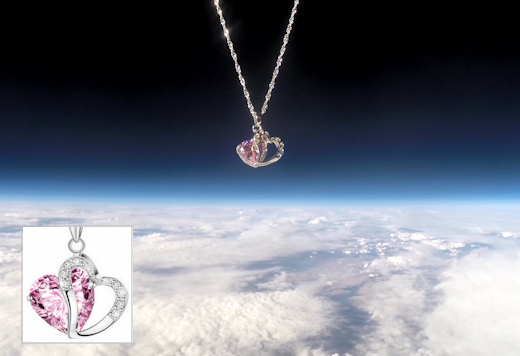
You can have it for $99.95. The students are selling these pendants as a fund-raiser for their cosmic ray monitoring program--and they make great Mother's Day gifts. All proceeds support atmospheric radiation measurements and hands-on STEM education.
Each pendant comes with a greeting card showing the jewelry in flight and telling the story of its journey to the stratosphere and back again. Mom-satisfaction guaranteed.
Far Out Gifts: Earth to Sky Store
All proceeds support hands-on STEM education
TWILIGHT GREEN: When the sun went down last night in Harstad, Norway, the colors of the sunset included blue, orange ... and green. "With Arctic summer fast approaching, our nights are disappearing rapidly, but I still keep an eye on the sky in case auroras appear," says Ross McLaughlin, who photographed the display:

"Despite low solar activity, the auroras were very bright. It's a wonderful to see them mixed with the colors of the twilight sky. I'll have to make the most of it while I can before the midnight sun arrives!"
This mixture of twilight blue + aurora green will continue to appear around the Arctic Circle for a few more weeks as the seasons change. Dates of special interest are April 9th - 12th when a wide stream of solar wind is expected to engulf Earth, possibly sparking 4 or 5 consecutive days of polar auroras.