A HOLE IN THE SUN'S ATMOSPHERE: A wide hole in the sun's atmosphere is facing Earth and spewing a stream of solar wind toward our planet. Estimated time of arrival: April 9th. Minor G1-class magnetic storms are possible next week when the gaseous material reaches Earth. Free: Aurora Alerts.


RED SPRITES AND THE PLEIADES: This week in the Czech republic, Martin Popek photographed a pair of red sprites leaping up from a thunderstorm 375 km away at the Czech-German border. "They were reaching toward the Pleiades star cluster--a very pretty sight," he says. "Sprite season has begun!"

Over the years, Popek has photographed hundreds of sprites from his private observatory in Nýdek. These are unusual, however, because of the date they appeared. "I photographed them on April 4th," he explains. "Sprites usually appear in late spring or summer when thunderstorm season is underway. These are quite early."
Sometimes called "space lightning," sprites inhabit the upper atmosphere alongside auroras and noctilucent clouds. Unlike ordinary lightning, which lance down from thunderstorms, sprites fly up. Some researchers believe sprites are linked to cosmic rays: subatomic particles from deep space strike the top of Earth's atmosphere, producing secondary electrons that spark the eerie red forms.
The link to cosmic rays is particularly interesting at this time. Recent measurements by space weather balloons and NASA spacecraft show that cosmic radiation is increasing. This is largely due to the decline of the solar cycle. Flagging solar wind pressure allows more cosmic rays into the inner solar system. If sprites and cosmic rays are truly linked, we may be seeing many more of both in the years ahead. Stay tuned.

MOTHER'S DAY IS ONLY 5 WEEKS AWAY: Nothing says "I Love You" like a heart-shaped pendant from the edge of space. On March 17, 2018, the students of Earth to Sky Calculus flew an array of cosmic ray sensors to the stratosphere onboard a giant helium balloon. This pendant went along for the ride:
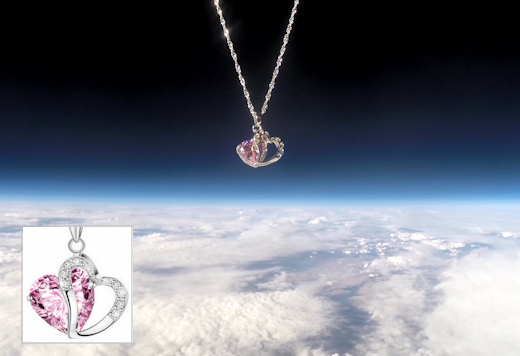
You can have it for $99.95. The students are selling these pendants as a fund-raiser for their cosmic ray monitoring program--and they make great Mother's Day gifts. All proceeds support atmospheric radiation measurements and hands-on STEM education.
Each pendant comes with a greeting card showing the jewelry in flight and telling the story of its journey to the stratosphere and back again. Mom-satisfaction guaranteed.
Far Out Gifts: Earth to Sky Store
All proceeds support hands-on STEM education
TWILIGHT GREEN: When the sun went down last night in Harstad, Norway, the colors of the sunset included blue, orange ... and green. "With Arctic summer fast approaching, our nights are disappearing rapidly, but I still keep an eye on the sky in case auroras appear," says Ross McLaughlin, who photographed the display:

"Despite low solar activity, the auroras were very bright. It's a wonderful to see them mixed with the colors of the twilight sky. I'll have to make the most of it while I can before the midnight sun arrives!"
This mixture of twilight blue + aurora green will continue to appear around the Arctic Circle for a few more weeks as the seasons change. Dates of special interest are April 9th - 12th when a wide stream of solar wind is expected to engulf Earth, possibly sparking 4 or 5 consecutive days of polar auroras.