CHANCE OF STORMS TODAY: NOAA forecasters say there is a 55% chance of minor G1-class geomagnetic storms on April 10th and 11th as a stream of solar wind gently buffets Earth's magnetic field. The gaseous material is flowing from a wide hole in the sun's atmosphere. Arctic sky watchers should be alert for auroras mixed with spring twilight. Free: Aurora Alerts.


APRIL SHOWERS: "It's amazing what a 4-second camera exposure will reveal on a good night--and last night was a good night, indeed!" reports aurora hunter Todd Salat, who snapped this picture on April 10th as Earth was entering a high-speed stream of solar wind:

"I was in the Knik River Valley in southcentral Alaska," says Salat. "The sky looked absolutely gorgeous reflecting in the water and had me oooooing & awwwwing."
"Did I really see it that brightly? Truthfully, no," he confesses. "The auroras were definitely fainter to the naked eye. Full disclosure: a camera is like Night Vision Goggles and picks up the subtle nuances of night light better than the human eye. But take a deep breath… inhale…. deeper…. and hear the murmur of the creek, fresh spring air on your face, and your eyes grow wide with wonder. That's how I felt anyway. Thank you Nikon D850 for all 45.7 megapixels, which allowed me to capture that feeling in an image."
More auroras are likely tonight as the same stream of solar wind continues to buffet Earth's magnetic field. Stay tuned for "April showers."
SPRINGTIME FIREBALL MYSTERY: The inner solar system is littered with dusty, gravelly debris from decaying comets and shattered asteroids. Every night Earth scoops up tons--literally tons--of this material, resulting in a slow drizzle of bright fireballs. Astronomers call them "sporadics." If you stay outside all night long, you might see as many as a dozen if the weather is clear.
On April 8th, a spectacular example split the sky over Veszprem, Hungary:

Photographer Monika Landy-Gyebnar reports: "I was out photographing the sunset, then waited until the International Space Station (ISS) and somewhat later the Progress MS-07 flew overhead. The fireball fell during the time between the two spacecraft. The flower in the foreground is a local pasque flower (Pulsatilla nigricans) which I wanted to include in my picture of the ISS."
Landy-Gyebnar says the magnitude of the fireball was about -10--in other words, more than 100 times brighter than the planet Venus.
Now for the mystery: Sporadic fireballs appear 10% to 30% more often during northern spring compared to other times of year--and no one knows why. "We've been aware of this phenomenon for more than 30 years," says Bill Cooke of NASA's Meteoroid Environment Office. "It's not only fireballs that are affected. Meteorite falls--space rocks that actually hit the ground--are more common in spring as well." Perhaps there is a diffuse swarm of meteoroids scattered in the April-May arc of Earth's orbit, giving rise to the extra fireballs. If so, its origin is unknown.
One thing is certain: Spring is fireball season, and a great time to catch unexpected meteors in photos of other things. Enjoy the show.
Realtime Space Weather Photo Gallery
MOTHER'S DAY IS ONLY 4 WEEKS AWAY: On March 5, 2018, the students of Earth to Sky Calculus flew a cosmic ray balloon to the stratosphere, more than 94,000 feet above Earth's surface. This sterling silver Mother's Day pendant went along for the ride:
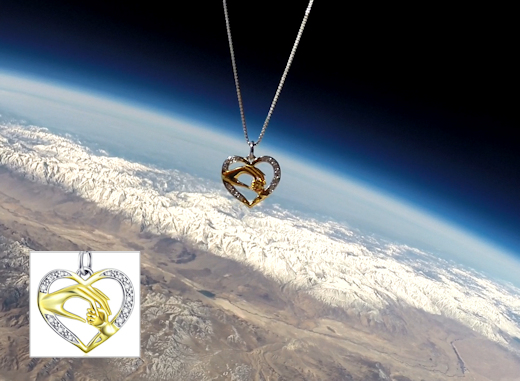
You can have it for $129.95. The students are selling these pendants as a fund-raiser for their cosmic ray monitoring program. All proceeds support atmospheric radiation measurements and hands-on STEM education.
Each pendant comes with a greeting card showing the jewelry in flight and telling the story of its journey to the stratosphere and back again. Mom-satisfaction guaranteed.
Far Out Gifts: Earth to Sky Store
All proceeds support hands-on STEM education