SOLAR WIND STORM: A stream of high-speed solar wind is buffeting Earth's magnetic field, and this is causing G1-class geomagnetic storms around the poles. Auroras have been sighted in the USA as far south as the Dakotas. The gaseous material is flowing from a wide hole in the sun's atmosphere--so wide that the stream could influence Earth for another 2 to 3 days. Free: Aurora Alerts


STEVE RETURNS (UPDATED WITH VIDEO): Last night in Alberta, Canada, photographer Alan Dyer looked up and saw a mauve ribbon of light bisecting the night sky. Auroras? Not exactly. "It was STEVE," says Dyer, who took these pictures of the glowing arc:

STEVE (Strong Thermal Emission Velocity Enhancement) often appears alongside auroras, but it is not the same thing. Researchers are only beginning to understand the phenomenon--aided by a chance encounter between STEVE and a European satellite. In situ measurements suggest that STEVE is the afterglow of a hot ribbon of gas that flows through Earth's magnetosphere during some geomagnetic storms.
Dyer caught STEVE just as it was fading. Other photographers saw a more spectacular display.
"My dog barked at STEVE for the entire hour it was visible," reports Matthew Wheeler of Robson Valley, British Columbia. "We spotted the ribbon just after midnight, and even without dark-adapted eyes it was easy to see the textures moving at astonishing speed." Click to view Wheeler's video of STEVE in motion:

Another video, looking straight up at STEVE, shows the beautiful interaction between the purple ribbon and nearby green "picket fence" auroras. "The purple ribbon was moving much faster than the green pickets," says Wheeler. "And while their forms varied from smooth to ragged and back again, their path across the sky was almost constant for the whole hour--as it has since I first noticed STEVE over this valley in the 1980s."
Much about STEVE remains a mystery. Researchers still don't understand why STEVE is purple, nor can they predict which geomagnetic storms will lure the arc out of hiding. Recent research suggests that STEVE loves equinoxes. The arc is seen most often during spring and fall. This means now is the season for STEVE. More sightings are possible in the nights ahead as the solar wind continues to blow.

MOTHER'S DAY IS ONLY 4 WEEKS AWAY: Nothing says "I Love You" like a heart-shaped pendant from the edge of space. On Dec. 31, 2017, the students of Earth to Sky Calculus flew an array of cosmic ray sensors to the stratosphere onboard a giant helium balloon. This pendant went along for the ride:
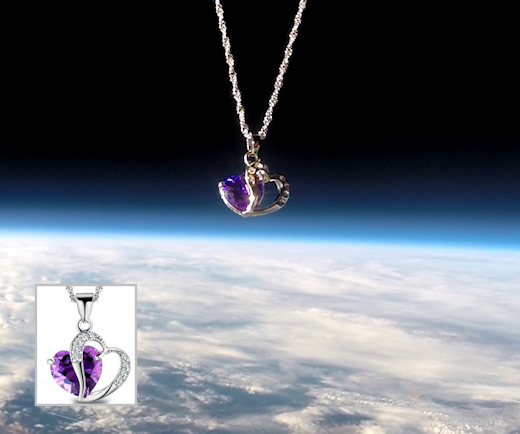
You can have it for $119.95. The students are selling these pendants as a fund-raiser for their cosmic ray monitoring program--and they make great Mother's Day gifts. All proceeds support atmospheric radiation measurements and hands-on STEM education.
Each pendant comes with a greeting card showing the jewelry in flight and telling the story of its journey to the stratosphere and back again. Mom-satisfaction guaranteed.
Far Out Gifts: Earth to Sky Store
All proceeds support hands-on STEM education