EXITING THE SOLAR WIND: Earth is exiting a stream of high-speed solar wind that sparked a G1-class geomagnetic storm and some very strange auroras earlier this week (April 9-11). NOAA says there is a 50% chance of polar geomagnetic storms today, subsiding to only 35% tomorrow. Free: Aurora Alerts

LAST AURORAS OF ARCTIC SPRING? Around the Arctic Circle, the midnight sun is coming, and sky watchers are bracing for a long summer without auroras. A G1-class geomagnetic storm on April 10-11 produced a bright display of lights over Scandinavia--and if it was the last display of the season, it was a good one:

"These may have been the spring season's last aurora," says photographer Aku Kankaanpää of Toholampi, Finland. "Summer is approaching and our darkness is fading away quickly."
In the southern hemisphere, of course, the situation is reversed. Researchers over-wintering in Antarctica are bracing for something quite different--months of velvety night and dancing Southern Lights. Stay tuned for images from the frozen continent.
MOTHER'S DAY IS LESS THAN 4 WEEKS AWAY: Nothing says "I Love You" like a heart-shaped pendant from the edge of space. On Dec. 31, 2017, the students of Earth to Sky Calculus flew an array of cosmic ray sensors to the stratosphere onboard a giant helium balloon. This pendant went along for the ride:
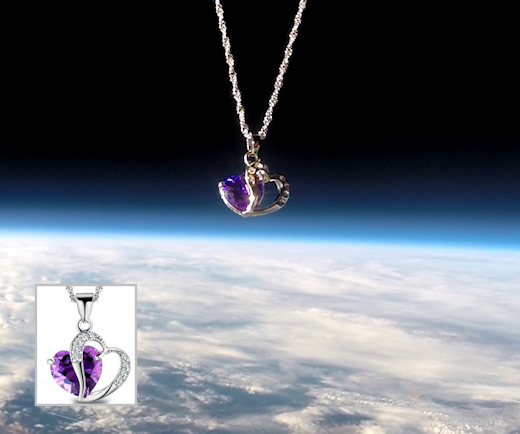
You can have it for $119.95. The students are selling these pendants as a fund-raiser for their cosmic ray monitoring program--and they make great Mother's Day gifts. All proceeds support atmospheric radiation measurements and hands-on STEM education.
Each pendant comes with a greeting card showing the jewelry in flight and telling the story of its journey to the stratosphere and back again. Mom-satisfaction guaranteed.
Far Out Gifts: Earth to Sky Store
All proceeds support hands-on STEM education
A SPACESHIP TRANSITS THE SUN: It happened in the blink of an eye. On April 10th, Maximilian and Eliza Teodorescu saw a large spacecraft fly in front of the sun. It was the International Space Station (ISS):

"I had the pleasure of photographing the ISS as it transited the sun over Romania--somewhere in the woods around Targoviste, together with my wife," says Maximilian. "The weather was perfect, and we were able to record many fine details in the station's silhouette."

Traveling at 17,000 mph, the orbiting outpost took only 0.8 seconds to cross the solar disk. "We knew exactly when to look thanks to predictions from CalSky," he says. "With the solar cycle at a low point, this is about the only way to see a large sunspot!"
