SOLAR WIND, INCOMING: A wide hole is opening in the sun's atmosphere, and it is spewing a stream of solar wind toward Earth. G1-class geomagnetic storms are possible when the gaseous material arrives on April 19-20. Sky watchers between 50o and 60o N latitude should also be alert for STEVE, which tends to appear in that latitude range during springtime geomagnetic storms. Free: Aurora Alerts


NEW COSMIC RAY DATA, COURTESY OF CAPT. UNDERPANTS: On March 29th, the students of Earth to Sky Calculus launched a space weather balloon to measure cosmic rays in the stratosphere--something they've been doing for more than 3 years in collaboration with Spaceweather.com. Their unique cosmic ray monitoring program is not supported by the NSF, NASA or government grants. Instead, we rely on individual sponsors. In this case, Capt. Underpants!

Actually, it was Tracy Stewart and Brian Elkington of West Valley City, UT, who did the sponsoring. They are the parents of two young scientists, Maxwell and Timothy Elkington, who wanted to fly Capt. Underpants and his sidekick Mousy to the edge of space. Tracy and Brian sponsored the launch of an Earth to Sky balloon with cosmic ray sensors onboard--and Capt. Underpants went along for the ride.
And a wild ride it was. The payload traveled more than 111,000 feet above Earth's surface, experiencing temperatures as low as -60 C and air pressures less than 0.2% of sea level. The cosmic ray dose rate at the apex of the flight (circled in red) was more than 100 times greater than on the Earth below:

After the balloon exploded, as planned, the payload parachuted back to Earth, landing in a rugged canyon near Panamint Butte on the verge of Death Valley. The recovery team hiked 14 miles to recover the payload. Capt. Underpants and Mousy survived the harrowing trip with a big grin and brought back great cosmic ray data for the students to analyze.
Thank you Tracy and Brian for supporting our program. PS: A video of Capt. Underpants in flight is being prepared. Stay tuned.
SURPRISE ASTEROID FLYBY: With little warning, a relatively large asteroid flew through the Earth-Moon system on April 15th only 192,200 km (0.5 LD) from our planet. 2018 GE3 was discovered by the Catalina Sky Survey approaching Earth on April 14th. Hours later, amateur astronomer Michael Jäger of Weißenkirchen Austria video-recorded the space rock rushing through the southern constellation Serpens:

"According to wikipedia, 2018 GE3 is the largest known asteroid to pass that close to Earth in observational history," says Jäger. "It was shining like a 13th magnitude star at the time of my observations."
Based on the intensity of its reflected sunlight, 2018 GE3 must be 48 to 110 meters wide, according to NASA-JPL. This puts it into the same class as the 60-meter Tunguska impactor that leveled a forest in Siberia in 1908. A more recent point of comparison is the Chelyabinsk meteor--a ~20-meter asteroid that exploded in the atmosphere over Russia on Feb. 15, 2013, shattering windows and toppling onlookers as a fireball brighter than the sun blossomed in the blue morning Ural sky. 2018 GE3 could be 5 to 6 times wider than that object.
If 2018 GE3 had hit Earth, it would have caused regional, not global, damage, and might have disintegrated in the atmosphere before reaching the ground. Nevertheless, it is a significant asteroid, illustrating how even large space rocks can still take us by surprise. 2018 GE3 was found less than a day before before its closest approach.
Based on an observational arc of only 1 day, 2018 GE3 appears to follow an elliptical orbit which stretches from the asteroid belt to deep inside the inner solar system. Every ~2.5 years the space rock crosses the orbits of Mercury, Venus, Earth, and Mars--although not necessarily making close approaches to the planets themselves. An interactive 3D orbit of the asteroid is available from JPL: explore it here!
Realtime Space Weather Photo Gallery
MOTHER'S DAY IS LESS THAN 1 MONTH AWAY:On March 5, 2018, the students of Earth to Sky Calculus flew a cosmic ray balloon to the stratosphere, more than 94,000 feet above Earth's surface. This sterling silver Mother's Day pendant went along for the ride:
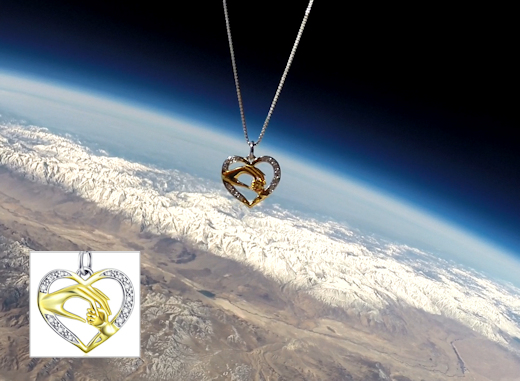
You can have it for $129.95. The students are selling these pendants as a fund-raiser for their cosmic ray monitoring program. All proceeds support atmospheric radiation measurements and hands-on STEM education.
Each pendant comes with a greeting card showing the jewelry in flight and telling the story of its journey to the stratosphere and back again. Mom-satisfaction guaranteed.
Far Out Gifts: Earth to Sky Store
All proceeds support hands-on STEM education