VENUS-MOON CONJUNCTION, TONIGHT: When the sun goes down tonight, step outside and look west. Weather permitting, you'll see an exquisitely slender crescent Moon shining right beside Venus. If possible, try to catch the pair before the sky fades to black. Bright conjunctions framed by twilight have a special beauty that you've got to see to believe. [sky map] [photos]

SOLAR WIND, INCOMING: A hole has opened in the sun's atmosphere, and it is spewing a stream of solar wind toward Earth. This extreme UV image from NASA's Solar Dynamics Observatory shows the gaseous rift:

G1-class geomagnetic storms and polar auroras are possible when the solar wind arrives on April 19-20. Sky watchers between 50o and 60o N latitude should also be alert for STEVE, an aurora-like phenomenon which tends to appear in that latitude range during springtime geomagnetic storms. Free: Aurora Alerts

NEW COSMIC RAY DATA, COURTESY OF CAPT. UNDERPANTS: On March 29th, the students of Earth to Sky Calculus launched a space weather balloon to measure cosmic rays in the stratosphere--something they've been doing for more than 3 years in collaboration with Spaceweather.com. The unique cosmic ray monitoring program is not supported by the NSF, NASA or government grants. Instead, we rely on individual sponsors--in this case, Capt. Underpants!

Actually, it was Tracy Stewart and Brian Elkington of West Valley City, UT, who did the sponsoring. They are the parents of two young scientists, Maxwell and Timothy Elkington, who wanted to fly Capt. Underpants and his sidekick Mousy to the edge of space. Tracy and Brian sponsored the launch of an Earth to Sky balloon with cosmic ray sensors onboard--and Capt. Underpants went along for the ride.
And a wild ride it was. The payload traveled more than 111,000 feet above Earth's surface, experiencing temperatures as low as -60 C and air pressures less than 0.2% of sea level. The cosmic ray dose rate at the apex of the flight (circled in red) was more than 100 times greater than on the Earth below:

After the balloon exploded, as planned, the payload parachuted back to Earth, landing in a rugged canyon near Panamint Butte on the verge of Death Valley. The recovery team hiked 14 miles to recover the payload. Capt. Underpants and Mousy survived the harrowing trip with a big grin and brought back great cosmic ray data for the students to analyze.
Thank you Tracy and Brian for supporting our program. PS: A video of Capt. Underpants in flight is being prepared. Stay tuned.
Realtime Space Weather Photo Gallery
MOTHER'S DAY IS LESS THAN 1 MONTH AWAY: Nothing says "I Love You" like a heart-shaped pendant from the edge of space. On March 17, 2018, the students of Earth to Sky Calculus flew an array of cosmic ray sensors to the stratosphere onboard a giant helium balloon. This pendant went along for the ride:
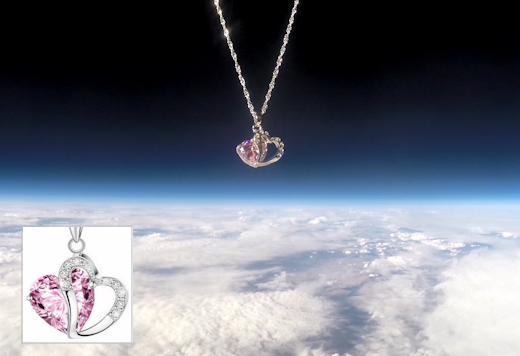
You can have it for $99.95. The students are selling these pendants as a fund-raiser for their cosmic ray monitoring program--and they make great Mother's Day gifts. All proceeds support atmospheric radiation measurements and hands-on STEM education.
Each pendant comes with a greeting card showing the jewelry in flight and telling the story of its journey to the stratosphere and back again. Mom-satisfaction guaranteed.
Far Out Gifts: Earth to Sky Store
All proceeds support hands-on STEM education