THE CRESCENT MOON AND ALDEBARAN: After passing Venus last night, the crescent Moon is en route to another close encounter--with Aldebaran, an orange giant star in the constellation Taurus. Look for them in the west after sunset as the sky fades to deep twilight. The Da Vinci Glow will also be visible; more on that below. [sky map] [photos]

WHAT IS THE DA VINCI GLOW? Five hundred years ago, Leonardo da Vinci proposed an outlandish theory explaining why the Moon's surface glows after lunar nightfall. Turns out, his idea was correct, and this week is a great time to see the "Da Vinci Glow." Mark A. Brown witnessed it last night when he was photographing the Moon-Venus conjunction over Alburnett, Iowa:

The Da Vinci Glow--also known as "Earthshine"--makes the entire lunar disk visible even when the sunlit fraction is just a few percent. "It was gorgeous," says Brown.
For much of human history, people marveled at the faint image of the full Moon inside the arms of the crescent. Where did it come from? No one knew until the 16th century when Leonardo figured it out. He realized that sunlight reflected from Earth lit up the lunar night.
Visualizing this in the 1500s required a wild kind of imagination. No one had ever been to the Moon and looked "up" at Earth. Most people didn't even know that Earth orbited the sun. Copernicus' sun-centered theory of the solar system wasn't published until 1543, twenty-four years after Leonardo died.
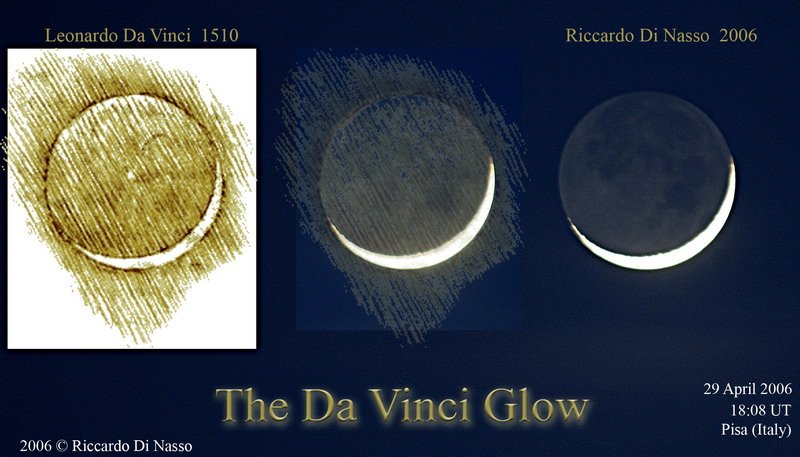
Above: Da Vinci's sketch of Earthshine in 1510 vs. Italian astronomer Riccardo Di Nasso's photo of Earthshine in 2006.
Wild imagination was one thing Leonardo had in abundance. His notebooks are filled with sketches of flying machines, army tanks, scuba gear and other fantastic devices centuries ahead of their time.
In Leonardo's Codex Leicester, circa 1510, there is a page entitled "Of the Moon: No Solid Body is Lighter than Air." He states his belief that the "ghostly glow" is due to sunlight bouncing off Earth's oceans and, in turn, hitting the Moon. 500 years later, we know that Earth's clouds (not oceans) do most of the reflecting; but that is a quibble. Leonardo understood the basics well enough.
Go outside tonight and look to the sky. The Da Vinci Glow is waiting....
Realtime Space Weather Photo Gallery
MOTHER'S DAY IS LESS THAN 1 MONTH AWAY: Nothing says "I Love You" like a heart-shaped pendant from the edge of space. On March 17, 2018, the students of Earth to Sky Calculus flew an array of cosmic ray sensors to the stratosphere onboard a giant helium balloon. This pendant went along for the ride:
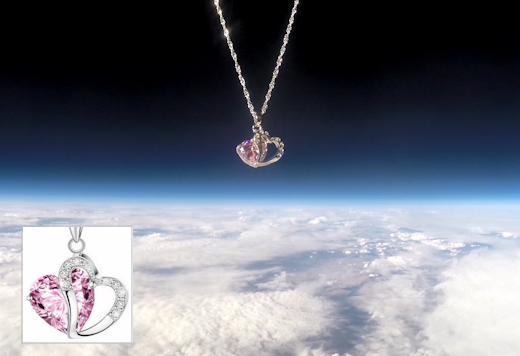
You can have it for $99.95. The students are selling these pendants as a fund-raiser for their cosmic ray monitoring program--and they make great Mother's Day gifts. All proceeds support atmospheric radiation measurements and hands-on STEM education.
Each pendant comes with a greeting card showing the jewelry in flight and telling the story of its journey to the stratosphere and back again. Mom-satisfaction guaranteed.
Far Out Gifts: Earth to Sky Store
All proceeds support hands-on STEM education
SOLAR WIND, INCOMING: A hole has opened in the sun's atmosphere, and it is spewing a stream of solar wind toward Earth. This extreme UV image from NASA's Solar Dynamics Observatory shows the gaseous rift:

G1-class geomagnetic storms and polar auroras are possible when the solar wind arrives on April 19-20. Sky watchers between 50o and 60o N latitude should also be alert for STEVE, an aurora-like phenomenon which tends to appear in that latitude range during springtime geomagnetic storms. Free: Aurora Alerts
