INTERPLANETARY SHOCK WAVE: An interplanetary shock wave hit Earth's magnetic field on April 19th around 23:50 UT. When the disturbance arrived, the density of solar wind flowing around our planet abruptly quadrupled and a crack opened in Earth's magnetic field. The resulting G2-class geomagnetic storm sparked unusual "electric blue" auroras.


"I've been flying airplanes for 20 years and photographing aurora for 10 years, but I've never seen anything like this before," reports pilot Matt Melnyk who photographed the display from 39,000 feet:

"Electric blue auroras!" he says. "This was while on a red eye flight from Edmonton to Toronto around 4 am over northern Manitoba. Unbelievable sky. I was able to grab some hasty shots with a cell phone."
Auroras are usually green--a sign of oxygen. Rare blue auroras are caused by nitrogen molecules. Energetic particles striking N2+ at the upper limits of Earth's atmosphere can produce an azure glow during intense geomagnetic storms.
During the storm, Northern Lights spilled across the Canadian border into the United States as far south as Indiana. Hongming Zheng, a student at Purdue University, saw the blue glow just five miles from his dorm:

"I was preparing for bed at 1:32 am on April 20th when I read that there was an Interplanetary Shockwave," says Zheng. "I immediately started driving north to see the show. A weak green wisp showed up at 2am and faded, but shortly after 5am a sudden outburst occurred. Purple pillars were easily visible to the naked eye. It's funny how one minute you are in a humid dorm struggling to get the laundry door closed, and the next minute you are chasing one of the most spectacular phenomenon known to man."
What is an interplanetary shock wave? It is a supersonic disturbance in the gaseous material of the solar wind. These waves are usually delivered by coronal mass ejections (CMEs). Indeed, this one might have been a minor CME that left the sun unrecognized earlier this week.
Alternately, it might have been an unusually sharp co-rotating interaction region (CIR). CIRs are transition zones between slow- and fast-moving streams of solar wind. They contain plasma density gradients and magnetic fields that often do a good job sparking auroras.
High latitude sky watchers should remain alert for auroras on April 20-21 as Earth's magnetic field continues to reverberate from the impact. Free: Aurora Alerts
MOTHER'S DAY IS JUST 3 WEEKS AWAY: Nothing says "I love you" like a heart-shaped pendant from the edge of space. On March 18, 2018, the students of Earth to Sky Calculus launched an array of cosmic ray sensors to the stratosphere onboard a helium balloon. This Mother's Day gift went along for the ride:
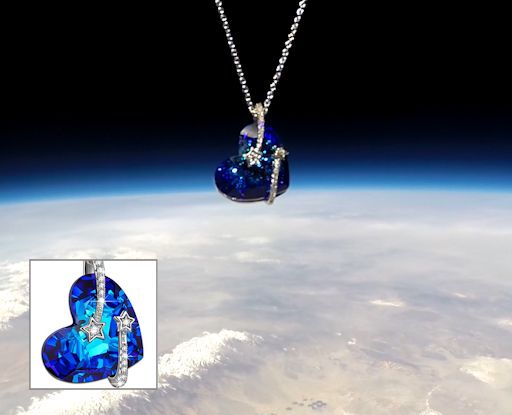
You can have it for $199.95. The students are selling these sterling silver pendants as a fund-raiser for their cosmic ray monitoring program. All proceeds support atmospheric radiation measurements and hands-on STEM education.
Each pendant comes with a greeting card showing the jewelry in flight and telling the story of its journey to the stratosphere and back again. Mom-satisfaction guaranteed.
Far Out Gifts: Earth to Sky Store
All proceeds support hands-on STEM education
HUBBLE TRANSITS THE MOON: Everyone loves pictures taken by the Hubble Space Telescope. On April 19th, Leo Caldas of Brasilia, Brazil, took a rare picture of the Hubble Space Telescope. He caught the iconic spacecraft transiting the Moon:

With some guidance from Calsky.com, "I was in the right place and time so see this unusual encounter," says Caldas. "At the time of the transit, Hubble was 891 km from me shining like a star of magnitude +3.5."