CHANCE OF MINOR STORMS: NOAA forecasters say there is a 55% chance of minor G1-class geomagnetic storms today, April 22nd, as Earth passes through the wake of an interplanetary shock wave. Arctic and Antarctic sky watchers should remain alert for auroras this weekend. Free: Aurora Alerts

WEEKEND METEOR SHOWER: Earth is entering a stream of debris from Comet Thatcher, source of the annual Lyrid meteor shower. If forecasters are correct, the Lyrids will peak this weekend with as many as 20 meteors per hour. Programmer Ian Webster created this interactive visualization of Comet Thatcher's dusty debris stream:
Occasionally Earth glides through an unusually dense clump of debris from Comet Thatcher, and this can cause a meteor outburst. For instance, one observer in the 19th century reportedly counted 167 Lyrids in 15 minutes. Another outburst in 1982 produced 90 Lyrids per hour. No such outburst is predicted for 2018—but then again, no outbursts were predicted on those previous occasions either. If you're up late, take a look.
The best time to see these meteors is during the hours before sunrise on Sunday, April 22, when the shower's radiant is high in the sky. Dress warmly. Bring a reclining chair, or spread a thick blanket over a flat spot of ground. Lie down and look up. Meteors can appear in any part of the sky, although their trails will tend to point back toward the constellation Lyra. [sky map]

MOTHER'S DAY IS JUST 3 WEEKS AWAY: On March 5, 2018, the students of Earth to Sky Calculus flew a cosmic ray balloon to the stratosphere, more than 94,000 feet above Earth's surface. This sterling silver Mother's Day pendant went along for the ride:
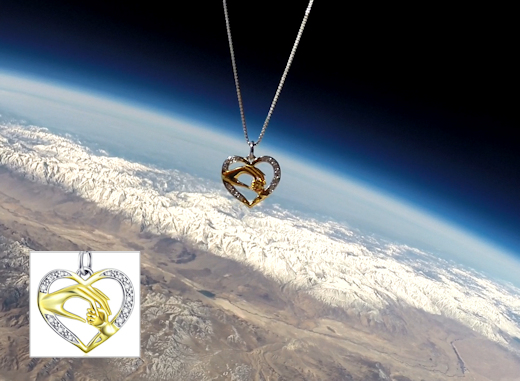
You can have it for $129.95. The students are selling these pendants as a fund-raiser for their cosmic ray monitoring program. All proceeds support atmospheric radiation measurements and hands-on STEM education.
Each pendant comes with a greeting card showing the jewelry in flight and telling the story of its journey to the stratosphere and back again. Mom-satisfaction guaranteed.
Far Out Gifts: Earth to Sky Store
All proceeds support hands-on STEM education
SOUTHERN LIGHTS: When an interplanetary shock wave hit Earth's magnetic field on April 19th, northern skies lit up with electric blue auroras. Southern skies lit up, too, but the palette was different. Peter Sayers sends this photo of red, yellow and green lights over Wilmot, Tasmania:

"Overlooking Wilmot and the iconic Mt Roland, we saw bright naked eye auroras lasting an hour or two," says Sayers. "They were stunning. I used Lightroom to clean up some noise, but the color saturation in this image was not altered from the camera."
Similar colors were observed in New Zealand, while Antarctic observers witnessed almost pure green.
What's the difference? Northern Lights stimulated by the shock wave were dominated by ionized nitrogen molecules, which produce a blue glow at the upper limits of Earth's atmosphere. Southern Lights, on the other hand, were dominated by oxygen. Oxygen atoms glow red and green when excited by incoming particles from space. Oxygen and nitrogen are abundant in both hemispheres--so why they dominated in different places is anyone's guess. Consider it a beautiful mystery.