SUBSIDING CHANCE OF STORMS: Geomagnetic activity is subsiding as Earth exits the gaseous wake of an interplanetary shock wave that rattled our planet's magnetic field on April 20th. NOAA forecasters say there is a 35% chance of minor geomagnetic storms today, dropping to only 10% tomorrow. Free: Aurora Alerts
LYRID METEOR SHOWER: This weekend, Earth passed through a stream of debris from Comet Thatcher, source of the annual Lyrid meteor shower. On Sunday morning northwest of Calgary, Alberta, Harlan Thomas witnessed a spectacular Lyrid fireball. "It was definitely the highlight of the morning," says Thomas. "The fireball graced our skies at 03:18 am and the smoke trail from the meteor lasted a good 90 seconds."


"I did manage to catch other meteors," he says, "but they were few and far between, somewhere around 10-15/hr."
Other observers around the world also counted about 10 Lyrids per hour--about normal for this minor shower. In previous years, Earth has occasionally passed through dense clumps of debris from Comet Thatcher, causing Lyrid outbursts of 90 or more per hour. So far in 2018 there have been no reports of such numbers. But as Thomas observed, sometimes a single meteor is plenty.
Realtime Space Weather Photo Gallery
MOTHER'S DAY IS JUST 3 WEEKS AWAY: On March 5, 2018, the students of Earth to Sky Calculus flew a cosmic ray balloon to the stratosphere, more than 94,000 feet above Earth's surface. This sterling silver Mother's Day pendant went along for the ride:
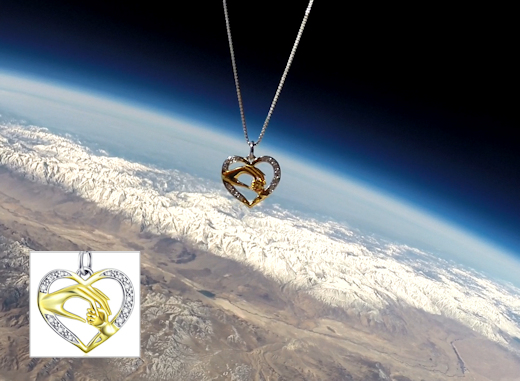
You can have it for $129.95. The students are selling these pendants as a fund-raiser for their cosmic ray monitoring program. All proceeds support atmospheric radiation measurements and hands-on STEM education.
Each pendant comes with a greeting card showing the jewelry in flight and telling the story of its journey to the stratosphere and back again. Mom-satisfaction guaranteed.
Far Out Gifts: Earth to Sky Store
All proceeds support hands-on STEM education
SOUTHERN LIGHTS: When an interplanetary shock wave hit Earth's magnetic field on April 19th, northern skies lit up with electric blue auroras. Southern skies lit up, too, but the palette was different. Peter Sayers sends this photo of red, yellow and green lights over Wilmot, Tasmania:

"Overlooking Wilmot and the iconic Mt Roland, we saw bright naked eye auroras lasting an hour or two," says Sayers. "They were stunning. I used Lightroom to clean up some noise, but the color saturation in this image was not altered from the camera."
Similar colors were observed in New Zealand, while Antarctic observers witnessed almost pure green.
What's the difference? Northern Lights stimulated by the shock wave were dominated by ionized nitrogen molecules, which produce a blue glow at the upper limits of Earth's atmosphere. Southern Lights, on the other hand, were dominated by oxygen. Oxygen atoms glow red and green when excited by incoming particles from space. Oxygen and nitrogen are abundant in both hemispheres--so why they dominated in different places is anyone's guess. Consider it a beautiful mystery.