SOLAR MINIMUM SUNSPOT: Solar minimum is approaching and, as a result, sunspot numbers are crashing toward zero. Nevertheless, there is a relatively large spot on the sun today. AR2706 has a primary core almost twice as wide as Earth, making it an easy target for backyard solar telescopes. So far AR2706 has produced no flares--a lassitude typical of solar minimum sunspots. Free: Aurora Alerts

THE MYSTERY OF LAST FRIDAY'S AURORAS: Before sunrise on Friday, April 20th, Northern Lights spilled across the Canadian border into almost a dozen US states. The unexpected display was seen from Washington to Maine, with sightings as far south as Illinois and Indiana. "The lights danced from sunrise to sunset," reports eyewitness Thomas Spence, who sends this picture from the Superior National Forest in the Arrowhead Region of Minnesota:
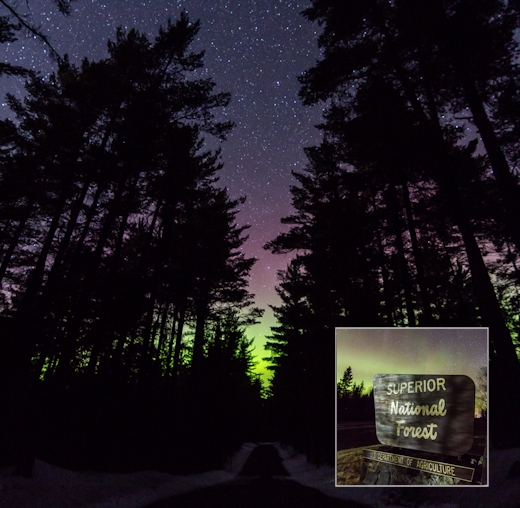
The display was sparked by an interplanetary shock wave that hit Earth's magnetic field during the waning minutes of April 19th. Interplanetary shock waves are supersonic disturbances in the solar wind, causing sudden discontinuities in the speed, temperature, and density of gaseous material blowing around our planet. During periods of high solar activity, these shocks are routinely delivered to Earth by coronal mass ejections (CMEs)--that is, big explosions on the sun.
And therein lies the mystery.
There was no big explosion on the sun last week. So what caused the shock wave? No one knows. Despite the fact that there are multiple satellites keeping an eye on the sun 24/7, we missed something. The stealthy disturbance left the surface of the sun and traveled across the sun-Earth divide, unseen and undetected for several days, before it hit, sparking a moderately strong G2-class geomagnetic storm attended by strangely colored, widespread auroras. Surprises are still possible in space weather, after all.

MOTHER'S DAY IS JUST 3 WEEKS AWAY: Nothing says "I love you" like a heart-shaped pendant from the edge of space. On March 18, 2018, the students of Earth to Sky Calculus launched an array of cosmic ray sensors to the stratosphere onboard a helium balloon. This Mother's Day gift went along for the ride:
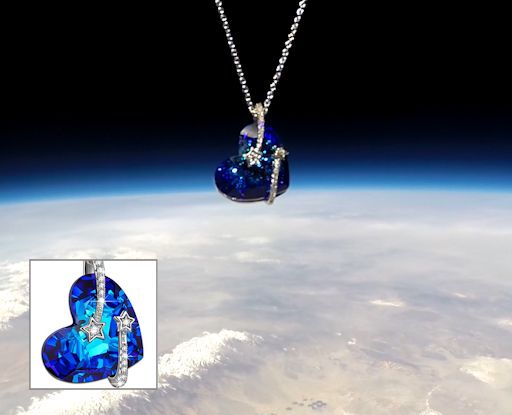
You can have it for $199.95. The students are selling these sterling silver pendants as a fund-raiser for their cosmic ray monitoring program. All proceeds support atmospheric radiation measurements and hands-on STEM education.
Each pendant comes with a greeting card showing the jewelry in flight and telling the story of its journey to the stratosphere and back again. Mom-satisfaction guaranteed.
Far Out Gifts: Earth to Sky Store
All proceeds support hands-on STEM education
VOLCANIC SUNDOGS: Sundogs are common. The rainbow-colored splashes of light frequently appear on either side of the sun when sunbeams lance through icy cirrus clouds. On April 20th, Daryl Peterson of Anchorage, Alaska, witnessed an uncommon type of sundog. "They were volcanic," he says. Take a look at his photo, then scroll down for an explanation:
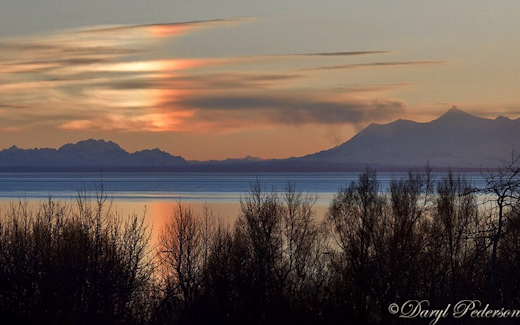
"From my location in Anchorage, I can easily see three active volcanoes in the ring of fire group that begins just 90 miles from here, across the Cook Inlet," says Pederson. "On April 20th I was scouting locations that would make great foregrounds for Northern Lights photography. For the first time in a long time I could see activity from all three volcanoes. Just before sunset an intense sundog formed from the steam that had been pumping out of the Mount Spurr stratovolcano."
The steamy exhaust was freezing in the cold Alaska air, forming the ice crystals required for sundog formation. "These rare sundogs were made even more impressive by their reflection on the water," says Pederson.