INCOMING SOLAR WIND STREAM: A stream of solar wind is approaching Earth and it could graze our planet's magnetic field on April 26th. The gaseous material is flowing from a northern hole in the sun's atmosphere. The stream won't hit our planet head on, but sometimes grazing impacts produce interesting effects--for instance, making Earth's magnetosphere ring like a bell. Free: Aurora Alerts

HURRICANE SPRITES: Atlantic hurricane season is little more than 1 month away. On the island of Puerto Rico, Frankie Lucena is looking forward to the coming storms with a mixture of excitement and dread. He's still struggling to keep regular power supplied to his private observatory 7 months after Hurricane Maria devastated the island last season. At the same time he knows that passing storms produce something he loves to observe: sprites and gigantic jets.
"Tropical storm (later hurricane) Harvey was by far the most prolific," he recalls. Here are four of the upward-lancing forms he photographed when the storm swirled south of Puerto Rico on Aug. 19, 2017:


"Harvey was a 'TLE Paradise' that night, playing host to wide variety of Transient Luminous Events," says Lucena. "The four events pictured above occurred within a 1 hour period and they were conveniently placed, so I decided to stack them. The one at the extreme left is a sprite, and the rest are Gigantic Jet lightning events."
Lucena's photos of "hurricane sprites" are a testament to his dedication and resourcefulness. After Hurricane Maria knocked out power to Puerto Rico last year, he continued taking pictures, powering his cameras using a gasoline generator and a backup battery. "I wish I had solar power at my house because the lines for gasoline were very long and money spent on it really hurt the pocket. We went 82 days without power," he adds.
How severe storms produce sprites and jets is an area of cutting edge research--and the data are not easy to obtain. The 2018 hurricane season is expected to bring another battery of storms. Lucena would like to avoid another direct hit but, he says, "bring on the sprites."
NOW THAT'S A HOMER: No one has ever hit a Red Sox baseball this far before. On Apr. 22, 2018, the students of Earth to Sky Calculus launched one to the edge of space on board a cosmic ray balloon. Riding alongside an array of radiation sensors, the commemorative baseball sailed 33.4 km (109,580 feet) above Earth's surface:

You can have it for $139.95. The students are selling space baseballs as a fund-raiser for their cosmic ray monitoring program. All proceeds support atmospheric radiation measurements and hands-on STEM education.
Are you a fan of a different team? The payload also carried commemorative baseballs for the Royals, Dodgers, Cubs, Yankees, Padres, and Giants. During checkout, enter your preferred team in the COMMENTS section. We will send you the corresponding baseball. If your home team is not on the list, let us know and we will fly it for you on an upcoming flight.
Far Out Gifts: Earth to Sky Store
All proceeds support hands-on STEM education
VOLCANIC SUNDOGS: Sundogs are common. The rainbow-colored splashes of light frequently appear on either side of the sun when sunbeams lance through icy cirrus clouds. On April 20th, Daryl Peterson of Anchorage, Alaska, witnessed an uncommon type of sundog. "They were volcanic," he says. Take a look at his photo, then scroll down for an explanation:
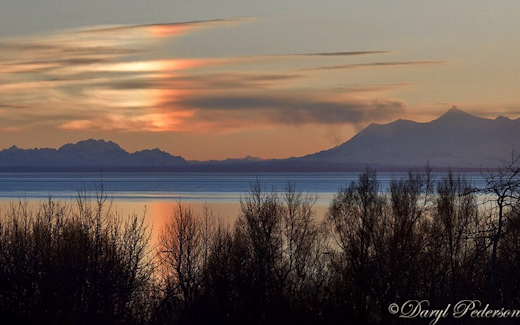
"From my location in Anchorage, I can easily see three active volcanoes in the ring of fire group that begins just 90 miles from here, across the Cook Inlet," says Pederson. "On April 20th I was scouting locations that would make great foregrounds for Northern Lights photography. For the first time in a long time I could see activity from all three volcanoes. Just before sunset an intense sundog formed from the steam that had been pumping out of the Mount Spurr stratovolcano."
The steamy exhaust was freezing in the cold Alaska air, forming the ice crystals required for sundog formation. "These rare sundogs were made even more impressive by their reflection on the water," says Pederson.