INCOMING SOLAR WIND STREAM: A stream of solar wind is approaching Earth and it could graze our planet's magnetic field on April 26th or 27th. The gaseous material is flowing from a northern hole in the sun's atmosphere. The stream won't hit our planet head on, but sometimes grazing impacts produce interesting effects--for instance, making Earth's magnetosphere ring like a bell. Free: Aurora Alerts

CELL PHONE CAPTURES ISS TRANSIT: Catching the International Space Station (ISS) as it crosses in front of the sun has become a favorite challenge for many astrophotographers. The silhouette of the giant spacecraft is like a large sunspot, theoretically easy to photograph, but tricky in practice because ISS transits last only a split second. Now, perhaps for the first time, someone has done it using a cell phone camera. Norman Carlson sends this image from Douglas, Arizona:

"Of course, there are sharper, clearer images on SpaceWeather.com of ISS transits across the sun, but probably not many that used a cell phone camera to record the passage," says Carlson. "Because the transit only lasted 0.58 seconds, I used the video mode of the cell phone camera at 30 frames per second, and mounted the cell phone over the eyepiece of a 6-inch Dobsonian reflector with a solar filter. Watching on the screen of the phone, I didn't see it dart by. On a computer monitor, though, and slowed down, it's clearly identifiable as the ISS."
Carlson knew when and where to look using predictions from Calsky.com. "Not bad for a cell phone camera," he says.
Realtime Space Weather Photo Gallery
RADIO STORM ON JUPITER: Yesterday, a radio storm happened on Jupiter. Astronomers have known since 1954 that the giant planet sometimes produces powerful bursts of shortwave static. Thomas Ashcraft recorded such a burst on April 24th using his amateur radio telescope in New Mexico. Click to hear the crackling "swooshes" that filled his observatory during the 2 hour storm:

"It was one of the better storms of the year so far," says Ashcraft. "In the audio specimen you can hear the emissions on two of my shortwave radios. One radio is tuned to 21.1 MHz and the other at 18.9 MHz." (Plug stereo headphones into your computer; they will separate the two frequencies into left and right ears.)
Radio storms on Jupiter come from natural radio lasers in the giant planet's magnetosphere. Electrical currents flowing between Jupiter's upper atmosphere and the volcanic moon Io can boost these emissions to power levels easily detected by ham radio antennas on Earth.
Jupiter's outbursts could become more intense in the weeks ahead. Why? Because the distance between Jupiter and Earth is shrinking to a minimum on May 10th. "As Jupiter passes closer to Earth in our orbits, the periodic Io-induced radio storms should get stronger," notes Ashcraft.
To learn more about radio storms on Jupiter, and how you can observe them yourself, visit NASA's RadioJove web site.
FAR-OUT MOTHER'S DAY GIFT: Nothing says "I Love You" like a heart-shaped pendant from the edge of space. On Dec. 31, 2017, the students of Earth to Sky Calculus flew an array of cosmic ray sensors to the stratosphere onboard a giant helium balloon. This pendant went along for the ride:
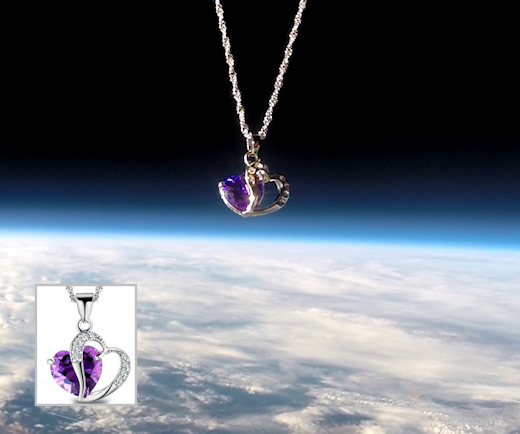
You can have it for $119.95. The students are selling these pendants as a fund-raiser for their cosmic ray monitoring program--and they make great Mother's Day gifts. All proceeds support atmospheric radiation measurements and hands-on STEM education.
Each pendant comes with a greeting card showing the jewelry in flight and telling the story of its journey to the stratosphere and back again. Mom-satisfaction guaranteed.
Far Out Gifts: Earth to Sky Store
All proceeds support hands-on STEM education