INCOMING SOLAR WIND STREAM: A stream of solar wind is approaching Earth and it could graze our planet's magnetic field on April 26th or 27th. The gaseous material is flowing from a northern hole in the sun's atmosphere. The stream won't hit our planet head on, but sometimes grazing impacts produce interesting effects--for instance, making Earth's magnetosphere ring like a bell. Free: Aurora Alerts

NORTH KOREA AND AVIATION RADIATION: For the past 4 years, Spaceweather.com and Earth to Sky Calculus have been flying radiation sensors onboard airplanes to map the distribution of cosmic rays around our planet. Our database currently contains more than 17,000 GPS-tagged radiation measurements spanning 5 continents and 43,000 feet of altitude. Yesterday, we realized we could use this database to investigate a current event--namely, the possibility of a radiation leak from North Korea.

Above: Earth to Sky Calculus X-ray/gamma radiation sensors onboard a plane flying near N. Korea.
North Korea recently surprised observers by announcing a suspension of its underground nuclear testing program. Geologists in China quickly offered an explanation: Mount Mantap, which sits atop of the test site, had collapsed. The mountain crumbled in Sept. 2017 minutes after the North Korean regime exploded a 100 kiloton prototype weapon. According to the South China Morning Post, the China Earthquake Administration believes the collapse may have created a "chimney" that allows the escape of radioactive materials.
Is there any sign of radioactivity in the air space around North Korea? Our database contains four flights near the Korean Peninsula--two in March 2016 (before the collapse), and two more in Feb. 2018 (after the collapse). These are shown in the map, below, where orange circles of 350 miles and 700 miles radius are centered on nuclear test site. During each flight we sampled X-rays and gamma-rays in the energy range 10 keV to 20 MeV at one minute intervals, accumulating more than 600 data points. Low energy X-rays have been used in the past to trace radioactive fallout from atomic tests, so our measurements may have some bearing on the question.

Above: In this map, red dots show where we have collected radiation data in airspace near N. Korea.
And the answer is .... no. We found no significant difference in radiation levels before and after the mountain's collapse. For instance, radiation dose rates in March 2016 at 31,500 feet were 0.9 uGy/hr (18 times the natural rate at sea level). Radiation dose rates in February 2018 at the same altitude were 1.0 uGy/hr (20 times sea level), a slight increase within the uncertainty of our measurements. If radiation is indeed leaking from the collapsed mountain site, we could not find it in our flights over neighboring countries.
FAR-OUT MOTHER'S DAY GIFT: Mother's Day is less than 3 weeks away. To get ready, the students of Earth to Sky Calculus launched an array of cosmic ray sensors to the stratosphere onboard a helium balloon. This Mother's Day pendant went along for the ride:
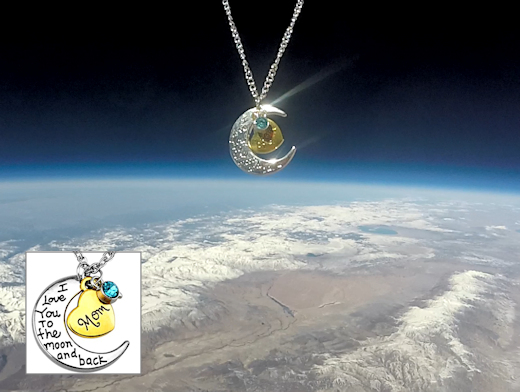
You can have it for $99.95. The students are selling these pendants as a fund-raiser for their cosmic ray monitoring program--and they make great Mother's Day gifts. All proceeds support atmospheric radiation measurements and hands-on STEM education.
Each pendant comes with a greeting card showing the jewelry in flight and telling the story of its journey to the stratosphere and back again. Mom-satisfaction guaranteed.
Far Out Gifts: Earth to Sky Store
All proceeds support hands-on STEM education
WHAT LIES INSIDE A RAINBOW: The next time you see a rainbow, look carefully at the colors. There's red on the outside, followed by orange, yellow, green and, finally, on the inside, blue. That's how a rainbow stops--on blue. Except this rainbow, photographed on April 25th by Honor Wheeler of Kent, UK, kept going. Blue, green, blue, green, blue, green:

"Crazy weather in Kent produced these rainbows," says Wheeler. "The colors were gorgeous."
Atmospheric optics expert Les Cowley explains: "The extra bows just inside the primary rainbow are called supernumeraries. They were so named because 17th century theories of the rainbow could not explain them -- they were thought of as extras and not supposed to exist. Now we know supernumeraries are produced by the interference between light waves when raindrops are unusually small."
Realtime Space Weather Photo Gallery