SOLAR WIND GRAZES EARTH: A weak stream of solar wind is grazing Earth's magnetic field today. The gaseous material is flowing from a northern hole in the sun's atmosphere, pointing not-quite-directly at our planet. NOAA forecasters estimate a 35% chance of polar geomagnetic activity in response to this grazing event. Free: Aurora Alerts

A SPECIAL CONJUNCTION OF THE MOON AND JUPITER: This weekend, the Moon and Jupiter are converging for their brightest conjunction of the year. When the Moon becomes full on Sunday night, April 29th, only ~5 degrees of arc will separate the pair inside the constellation Libra:

Conjunctions between the Moon and Jupiter are not uncommon--but this one is special. It's happening only days before Jupiter's closest approach to Earth in early May. As a result of its proximity, Jupiter is shining brighter than any star in the night sky. For instance, on the night of the conjunction Jupiter will be almost 3 times brighter than brilliant Sirius. The giant planet will have no trouble being seen next to the glaring full Moon.
Do you have a backyard telescope? Point it at Jupiter. Even cheap department store optics will reveal Jupiter's alternating cloud belts and four largest moons: Io, Europe, Callisto and Ganymede.
Finding the conjunction is easy. Just look east-southeast after sunset. You'll see the Moon and Jupiter rising together as a pair. They will remain visible all night long, highest in the sky at midnight, but beautiful at any time. Enjoy the show! Sky maps: April 28, 29, 30.


Realtime Space Weather Photo Gallery
FAR-OUT MOTHER'S DAY GIFT: Mother's Day is less than 3 weeks away. To get ready, the students of Earth to Sky Calculus launched an array of cosmic ray sensors to the stratosphere onboard a helium balloon. This Mother's Day pendant went along for the ride:
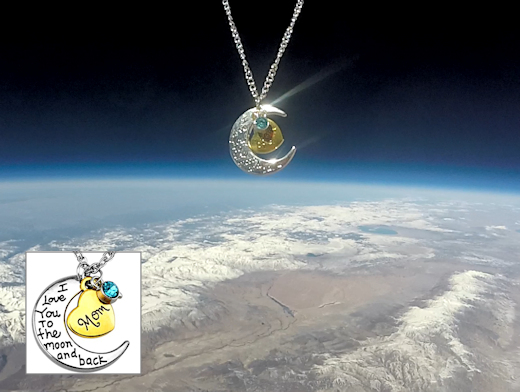
You can have it for $99.95. The students are selling these pendants as a fund-raiser for their cosmic ray monitoring program--and they make great Mother's Day gifts. All proceeds support atmospheric radiation measurements and hands-on STEM education.
Each pendant comes with a greeting card showing the jewelry in flight and telling the story of its journey to the stratosphere and back again. Mom-satisfaction guaranteed.
Far Out Gifts: Earth to Sky Store
All proceeds support hands-on STEM education
WHAT LIES INSIDE A RAINBOW: The next time you see a rainbow, look carefully at the colors. There's red on the outside, followed by orange, yellow, green and, finally, on the inside, blue. That's how a rainbow stops--on blue. Except this rainbow, photographed on April 25th by Honor Wheeler of Kent, UK, kept going. Blue, green, blue, green, blue, green:

"Crazy weather in Kent produced these rainbows," says Wheeler. "The colors were gorgeous."
Atmospheric optics expert Les Cowley explains: "The extra bows just inside the primary rainbow are called supernumeraries. They were so named because 17th century theories of the rainbow could not explain them -- they were thought of as extras and not supposed to exist. Now we know supernumeraries are produced by the interference between light waves when raindrops are unusually small."
Realtime Space Weather Photo Gallery