THE FULL MOON AND JUPITER: When the sun goes down tonight, step outside and look east. If you have a clear view of the horizon, you'll see Jupiter and the full Moon rising together in the constellation Libra. They'll be shining side-by-side all night long, soaring high in the southern sky at midnight. Jupiter is unusually bright because it is nearing its closest approach to Earth. This makes the conjunction extra-luminous and visible even from light polluted urban areas. Sky maps: April 29, 30.


FULL MOON HALOS: The Moon is full. That means it's time to be alert for Moon halos. Maxime Spano photographed this one last night from the La Silla Observatory in Chile:

Moon halos are caused by ice crystals in cirrus clouds, which catch rays of moonlight and bend them into a 22o ring. Bright full Moons are great at making these halos--and you don't have to be in a cold place to see them. Halo-forming ice crystals float 5 km to 10 km above the ground where the air is always freezing regardless of the season.
"I'm currently observing using the Euler Swiss telescope," says Spano. "Last night's sky was quite hazy, not nice for my observations, but perfect for Moon halos. Jupiter had the good idea to be exactly 22 degrees from the Moon and, as a result, happened to be a nice add-on to the halo itself."
Realtime Space Weather Photo Gallery
FAR-OUT MOTHER'S DAY GIFT: Mother's Day is only two weeks away. To get ready, the students of Earth to Sky Calculus launched an array of cosmic ray sensors to the stratosphere onboard a helium balloon. This Mother's Day gift went along for the ride:
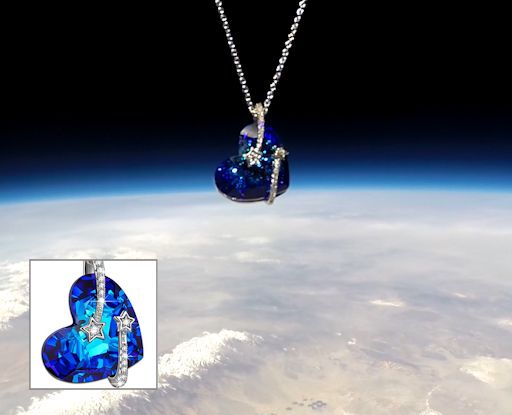
You can have it for $199.95. The students are selling these sterling silver pendants as a fund-raiser for their cosmic ray monitoring program. All proceeds support atmospheric radiation measurements and hands-on STEM education.
Each pendant comes with a greeting card showing the jewelry in flight and telling the story of its journey to the stratosphere and back again. Mom-satisfaction guaranteed.
Far Out Gifts: Earth to Sky Store
All proceeds support hands-on STEM education
THE GOLDEN HANDLE: Once a month, about 4 days before the full Moon, the sun rises behind the Moon's towering Jura Mountains. For a few magic hours, sunlight dances along the mountain crest while the hardened lava plains below remain in darkness. These are the hours of the Golden Handle. Peter Lowenstein observed the phenomenon on April 26th from Mutare, Zimbabwe:

"I was lucky to catch it," says Lowenstein. "The night sky was perfectly clear when the crest of the Jura Mountains lit up, curving around the edge of Sinus Iridium (the Bay of Rainbows) to form the Golden Handle. This only happens when the Moon is about 11 days old."
The Golden Handle was famously depicted in Stanley Kubrick's 2001: a Space Odyssey when the lunar lander Aries departed en route to the Moon. It's next appearance is slated for May 25, 2018, when the sun rises again over Montes Jura. Lunar photographers, mark your calendar.
Realtime Space Weather Photo Gallery