THE FIRST SOLAR WIND STREAM OF MAY: A hole in the sun's atmosphere is turning toward Earth, spewing a stream of solar wind that should reach our planet on May 6th. NOAA forecasters say G1-class geomagnetic storms are possible when the gaseous material arrives. High latitude sky watchers should be alert for weekend auroras, especially in the southern hemisphere where deepening autumn darkness favors the visibility of Southern Lights. Free: Aurora Alerts.


SUNSPOTS VANISHING FASTER THAN EXPECTED: Sunspots are becoming scarce. Very scarce. So far in 2018 the sun has been blank almost 60% of the time, with whole weeks going by without sunspots. Today's sun, shown here in an image from NASA's Solar Dynamics Observatory, is typical of the featureless solar disk:

The fact that sunspots are vanishing comes as no surprise. Forecasters have been saying for years that this would happen as the current solar cycle ("solar cycle 24") comes to an end. The surprise is how fast.
"Solar cycle 24 is declining more quickly than forecast," stated NOAA's Space Weather Prediction Center on April 26th. This plot shows observed sunspot numbers in blue vs. the official forecast in red:

"The smoothed, predicted sunspot number for April-May 2018 is about 15," says NOAA. "However, the actual monthly values have been lower."
"Official" forecasts of the solar cycle come from NOAA's Solar Cycle Prediction Panel–a group of experts from NOAA, NASA, the US Air Force, universities and other research organizations. They have been convening at intervals since 1989 to predict the timing and intensity of Solar Max. The problem is, no one really knows how to predict the solar cycle. The most recent iteration of the panel in 2006-2008 compared 54 different methods ranging from empirical extrapolations of historical data to cutting-edge supercomputer models of the sun's magnetic dynamo. None fully described what is happening now.

CONTINUE READING THE FULL STORY...
FAR-OUT MOTHER'S DAY GIFT: Mother's Day is less than two weeks away. To get ready, the students of Earth to Sky Calculus launched an array of cosmic ray sensors to the stratosphere onboard a helium balloon. This sterling silver Mother's Day gift went along for the ride:
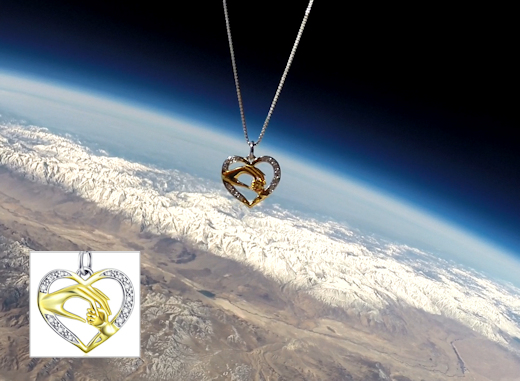
You can have it for $129.95. The students are selling these pendants as a fund-raiser for their cosmic ray monitoring program. All proceeds support atmospheric radiation measurements and hands-on STEM education.
Each pendant comes with a greeting card showing the jewelry in flight and telling the story of its journey to the stratosphere and back again. Mom-satisfaction guaranteed.
Far Out Gifts: Earth to Sky Store
All proceeds support hands-on STEM education
A GREEN FLASH TURNS BLUE: Green flashes at sunset are rare. Indeed, they were once thought mythological. Blue flashes are rarer still. Yesterday, Ronny Tertnes of Bergen, Norway, saw them both in a single sunset:

"There was a visible green flash in the sunset on April 29th," says Tertnes. "But that's not all. Just before the green flash, there was a very blue glow visible along the sun's upper edge--even more blue than I managed to capture in the photo."
Green flashes are formed when the prismatic action of the atmosphere splits the setting sun into basic R-G-B colors. Temperature inversions create a mirage, magnifying the green into an eye-catching flash.
Blue flashes are formed in the same way, but they are rarely seen. Why? Because blue light is scattered strongly by molecules in the air. The same Rayleigh scattering that smears blue light around the daytime sky also disperses and mutes sunset blue flashes.
Tertnes saw it anyway. "It was a great sunset," he says.
Realtime Space Weather Photo Gallery