THE SOLAR WIND HAS ARRIVED--AND IT'S EARLY: Earth is moving into a stream of solar wind flowing from a wide hole in the sun's atmosphere. Originally expected to reach our planet on May 6th or 7th, the fast-moving gas is here now instead. High-latitude sky watchers should be alert for auroras, particularly in the southern hemisphere where deepening autumn darkness favors the visibility of Southern Lights. Free: Aurora Alerts.

WEST COAST ROCKET BLASTS OFF FOR MARS: This morning, for the first time, NASA launched a rocket to Mars from the US west coast. Carrying the InSight Mars lander, an Atlas 5 rocket blasted off from the Vandenberg Air Force Base at 4:05 am and headed south, parallel to the coast. Dennis Mammana saw the Atlas 5 climb into the sky more than 300 miles away at the Joshua Tree National Park:

"With a waning gibbous moon illuminating the landscape and sky, the Atlas V appeared first as a cherry red glow on the west-northwestern horizon and continued toward the south as it crossed the Pacific Ocean on its way to Mars," says Mammana. "The shot is a quick blending of 35 separate exposures; the breaks within the rocket trail occur between exposures."
Because the launch occurred at the earliest possible moment in the launch window, 4:05 a.m., the rocket's exhaust had time to completely disperse before morning sunlight hit Earth's upper atmosphere about an hour later. As a result no noctilucent clouds were observed.
Realtime Space Weather Photo Gallery
FAR-OUT MOTHER'S DAY GIFT: Mother's Day is only a week away. To get ready, the students of Earth to Sky Calculus launched an array of cosmic ray sensors to the stratosphere onboard a helium balloon. This sterling silver Mother's Day gift went along for the ride:
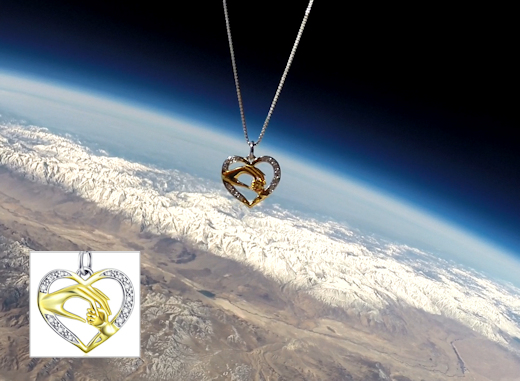
You can have it for $129.95. The students are selling these pendants as a fund-raiser for their cosmic ray monitoring program. All proceeds support atmospheric radiation measurements and hands-on STEM education.
Each pendant comes with a greeting card showing the jewelry in flight and telling the story of its journey to the stratosphere and back again. Mom-satisfaction guaranteed.
Far Out Gifts: Earth to Sky Store
All proceeds support hands-on STEM education
METEORS FROM HALLEY'S COMET: This weekend, Earth is passing through a stream of debris from Halley's Comet, source of the annual eta Aquariid meteor shower. Forecasters expect the shower to peak on May 6-7 with 20 meteors per hour in the northern hemisphere, and twice that number in the southern hemisphere. No matter where you live, the best time to look is during the hours before local sunrise on Monday morning, May 7th. [sky maps]
Programmer Ian Webster created this interactive visualization of Comet Halley's dusty debris stream passing through Earth's orbit: