EXITING THE SOLAR WIND STREAM: After five days inside a stream of high speed solar wind, Earth is finally making its exit. Solar wind speeds are gradually subsiding below 600 km/s. NOAA forecasters estimate a 40% chance of polar geomagnetic storms on May 9th, dropping to 30% on May 10th as we move away from the gaseous material. Free: Aurora Alerts
A CLOSE ENCOUNTER WITH JUPITER: This week, Jupiter makes its closest approach to Earth for 2018. Rising in the east at sunset, the giant planet is up all night long, shining brighter than any star in the sky. Paul Martini sends this picture from Bluff, Utah:

Bluff is the gateway to Utah's Bears Ears National Monument and the Valley of the Gods, where wind- and rain-sculpted sandstone formations jut beautifully out of the ground. "I caught Jupiter behind one of those formations using a 15 second exposure at ISO 12,800," says Martini.
If you have a telescope, point it at Jupiter. Even inexpensive department store telescopes will show the planet's cloudy bands and four largest moons. The exact date of closest approach is May 10th, but every night this week is a great time to see Jupiter.
Realtime Space Weather Photo Gallery
MOTHER'S DAY IS THIS SUNDAY: Nothing says "I Love You" like a heart-shaped pendant from the edge of space. On Dec. 31, 2017, the students of Earth to Sky Calculus flew an array of cosmic ray sensors to the stratosphere onboard a giant helium balloon. This Mother's Day gift went along for the ride:
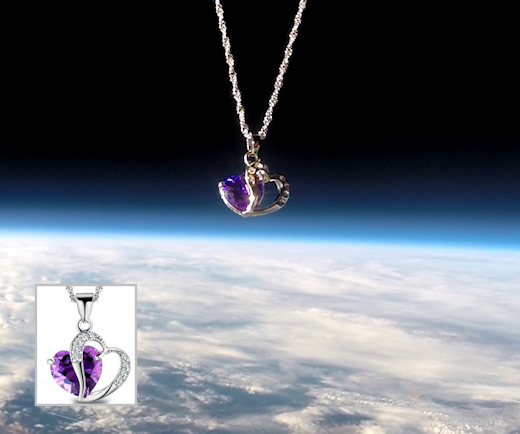
You can have it for $119.95. The students are selling these pendants as a fund-raiser for their cosmic ray monitoring program. All proceeds support atmospheric radiation measurements and hands-on STEM education.
Each pendant comes with a greeting card showing the jewelry in flight and telling the story of its journey to the stratosphere and back again. Mom-satisfaction guaranteed.
Far Out Gifts: Earth to Sky Store
All proceeds support hands-on STEM education
POLLEN CORONA: This spring in Europe has been remarkably warm and sunny, kickstarting a frenzy of vegetative reproduction. "The air is full of pollen," says Peter Paul Hattinga Verschure of Deventer, The Netherlands. "As a result, we've seen some beautiful pollen coronas." He photographed this one on May 8th:

"I used a street lamp to block the glare of the sun," says Verschure. "The colorful rings then became very clear."
Atmospheric optics expert Les Cowley explains the phenomenon: "Coronas are produced when light waves scatter from the outsides of small particles. Tiny droplets of water in clouds do a great job making coronas, but pollen grains are even better. They make small but very colorful rings of light around the sun."
"Unlike water droplets, pollens are non-spherical--and this adds to their magic," he continues. "Many have air sacs to help carry them in the wind. These align the grains to give beautiful elliptical coronas with bright spots." This is why Verschure's pollen corona looks the way it does.
"I believe the elliptical shape of this corona points to its origin in pine tree pollen," says Verschure. Look carefully at his photo and you can see individual specks of pollen glittering in the air.
