SPACE WEATHER SATELLITE WAKES UP (AGAIN): When amateur astronomer Scott Tilley re-discovered NASA's lost IMAGE satellite in January 2018, space weather forecasters celebrated. IMAGE is capable of taking pictures of Earth's global auroras unmatched by any other spacecraft. Hopes were dashed in February, however, when IMAGE went silent. Now, in a dizzying turn of events, "IMAGE's radio signal is back LOUD and clear!" reports Tilley. On May 9th, he picked up S-band transmissions from the satellite, and NASA engineers are scrambling to regain control. Fingers crossed! And stay tuned for updates.
AURORAS AT 37,000 FEET: Last night, May 11th, pilot Matt Melnyk was flying a red-eye over Alberta, Canada, when his cockpit window filled with green. "It was the aurora borealis," he says. "I took this picture from our cruising altitude of 37,000 feet at 01:00 am."

"Thankfully there was no turbulence, because it is very difficult to get hand held photos from a moving aircraft," says Melnyk.
The source of the display was the tail end of a solar wind stream that has been buffeting Earth's magnetic field since late on May 5th. The solar wind is subsiding now, but it will begin to gust again on May 16th -17th when a new stream arrives. Stay tuned for more auroras next week--and if you are flying at night, secure a window seat.
THIS PENDANT HAS TOUCHED SPACE: Mother's Day is tomorrow, and if you're still shopping online for a gift, you're in trouble. It won't arrive in time! That's why you need something special--like this pendant from space:
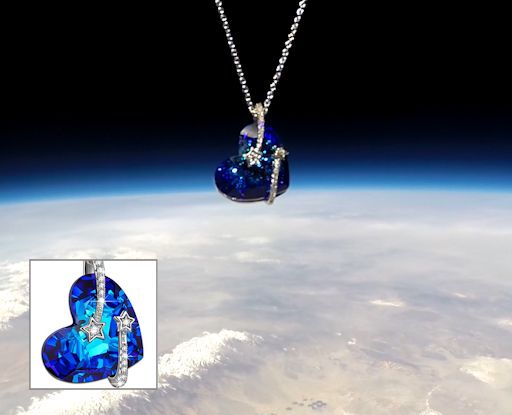
The students of Earth to Sky Calculus flew this pendant to the stratosphere onboard a cosmic ray balloon--and you can have it for $199.95. It makes a great belated Mother's Day gift.
Each pendant comes with a greeting card showing the jewelry in flight and telling the story of its journey to the stratosphere and back again. All proceeds support STEM education and the Earth to Sky cosmic ray monitoring program.
Far Out Gifts: Earth to Sky Store
All proceeds support hands-on STEM education
RED AIRGLOW OVER THE ATACAMA DESERT: When the sun goes down, Chile's Atacama desert can be one of the darkest places on Earth. Last night, it was not. "I couldn't believe what I saw on the screen of my camera when I took the first image," reports photographer Yuri Beletsky, who recorded luminous bands of red rippling across the sky:
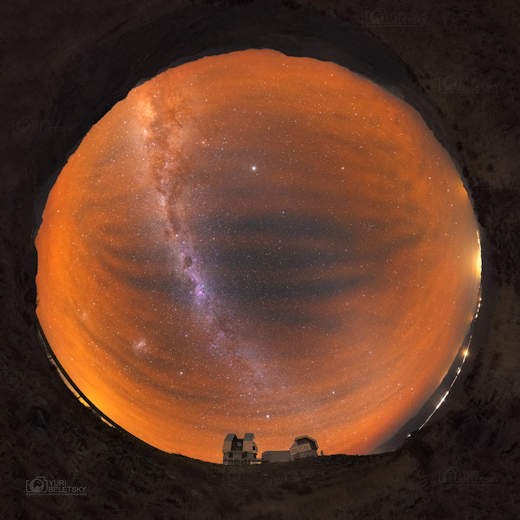
"The airglow was absolutely insane!" he says. "Parts of the Milky Way were barely visible because of the intense red glow."
Airglow is caused by a complex assortment of chemical reactions in the upper atmosphere. These reactions get started during daylight hours when the atmosphere is bathed in strong ultraviolet radiation from the sun. After sunset, the afterglow appears--usually green, but sometimes red. Beletsky is a veteran photographer of airglow, having captured it dozens of times from sites in Chile and the South Pacific. "The intensity of airglow varies, and sometimes it can be more prominent," he notes.
Last night, it was very prominent indeed. The red light came from OH radicals (chemical by-products of the daytime reactions) floating in a narrow layer 86 to 87 km above Earth's surface. Gravity waves propagating upward from the lower atmosphere impressed the thin red glow with a dramatic rippling structure.
"It seems the atmosphere is pretty active now," says Beletsky. "This is a good time to be alert for airglow."