CHANCE OF STORMS TODAY: NOAA forecasters say there is a 60% chance of G1-class geomagnetic storms during the late hours of May 17th when a stream of solar wind is expected to rattle Earth's magnetic field. The gaseous material is flowing from a southern hole in the sun's atmosphere. High-latitude sky watchers should be alert for auroras and, of course, STEVE. Free: Aurora Alerts.


A "SUPER" CRESCENT MOON AND VENUS: When the sun goes down tonight (May 17th), step outside and look west. A beautifully slender crescent Moon is passing by Venus in the twilight sky Take a closer look at that Moon. Does the crescent seem extra big and bright? You might be right. It's a "supermoon." (continued below)

On May 17th the Moon is at perigee--that is, the side of the Moon's elliptical orbit closest to Earth. This makes the Moon 5% wider and almost 11% brighter than average crescent moons of the same phase. You've probably heard the term "supermoon" applied to full Moons. It applies to crescents as well.
This is also a good night to see the Da Vinci Glow, also known as "Earthshine." Inside the arms of the lunar crescent there is a faint image of the full Moon. That is caused by sunlight reflected from Earth onto the dark lunar surface. In the northern hemisphere, Earthshine is extra visible in spring because springtime crescent Moons are high in the sky at sunset.
A springtime super crescent Moon with Earthshine and Venus? It doesn't get much better than that. Enjoy the show!

Realtime Space Weather Photo Gallery
3D GLOWING MOON GLOBE: Are you looking for a far-out gift? Consider this: In January, the students of Earth to Sky Calculus flew a glowing 3D printed Moon globe to the stratosphere:
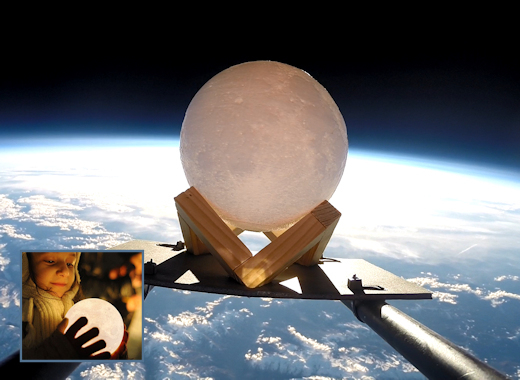
You can have it for $149.95. The students are selling these unique globes as a fundraiser for their cosmic ray monitoring program.
The surface of the sphere is an accurate topo-map of lunar terrain, tracing every major crater and mountain range. It is also a night light. A built-in USB-rechargeable battery provides up to 20 hours of illumination.
Each glowing orb comes with a greeting card showing the Moon in flight and telling the story of its journey to the edge of space. All proceeds support Earth to Sky Calculus and hands-on STEM research.
Far Out Gifts: Earth to Sky Store
All proceeds support hands-on STEM education
WHAT THE NEW MOON REALLY LOOKS LIKE: The New Moon is supposed to be entirely black, right? Wrong. Astrophotographer Thierry Legault photographed this week's New Moon over Normandy, France, and he found an exquisitely-thin crescent of light:

"I went to Normandy to find the clear sky I needed to photograph this crescent at the exact moment of the New Moon (May 15th at 11:48 UTC)," says Legault. "This is the youngest possible crescent, the age of the Moon at this instant being exactly zero. The irregularities and discontinuities in the crescent are real; they are caused by mountains and craters at the edge of the lunar disk."
The Moon was only 5 degrees from the sun in broad daylight when Legault took the picture. "At this very small separation, the crescent is extremely thin (a few arc seconds at maximum) and, above all, it is drowned in the solar glare, the blue sky being about 1000 times brighter than the crescent itself. In order to reduce the glare, I used an infrared filter and a pierced screen in front of the telescope to prevent stray sunlight from entering." he explains.

Seeing this image for the first time, most people wonder Has anyone ever done this before? The answer is "yes." Thierry Legault himself did it in 2010 and 2013. For some astrophotographers, the incredible is routine. Congratulations, Theirry, on another great capture.
Note: The reason the New Moon isn't always black is that the Moon's orbit around Earth is tilted with respect to the Moon's orbit around the sun. Occasionally, this allows the New Moon to be as far from the sun as 5 degrees, with a crescent to show for it.