CHINA IS GOING TO THE FARSIDE OF THE MOON: Later this year, China's space agency plans to soft-land a probe on the rugged farside of the Moon. No nation has ever done this before, and it won't be easy. Simply communicating with the lander will be a challenge. This morning, May 21st, China successfully launched a satellite named Queqiao (Chinese for "Magpie Bridge") to relay signals between the lunar farside and Earth. Now preparations can begin to launch the lander itself. Congratulations to China for a big step into the unknown. [full story]
ATMOSPHERIC RADIATION UPDATE: Cosmic rays over California continue to intensify, according to high-altitude balloons launched by Spaceweather.com and the students of Earth to Sky Calculus. We've been monitoring secondary cosmic rays in the stratosphere with regular launches from Bishop CA since 2015. In this data plot, just updated with new measurements from May 2018, we see that 3 of the 4 highest readings occurred just in the past few months:

The worsening cosmic ray situation is linked to the solar cycle. Right now, the sun is heading toward a deep Solar Minimum. As the outward pressure of solar wind decreases, cosmic rays from deep space are able to penetrate the inner solar system with increasing ease. This same phenomenon is happening not only above California, but all over the world.
Take another look at the data plot. The general trend in radiation is increasing, but it is not perfectly linear. From launch to launch we see significant up and down fluctuations. These fluctuations are not measurement errors. Instead, they are caused by natural variations in the pressure and magnetization of the solar wind.

The sensors we send to the stratosphere measure X-rays and gamma-rays, which are produced by the crash of primary cosmic rays into Earth's atmosphere. The energy range of the sensors, 10 keV to 20 MeV, is similar to that of medical X-ray machines and airport security scanners. Stay tuned for updates as the monitoring program continues.
Realtime Space Weather Photo Gallery
SOLAR WIND TO GRAZE EARTH: Minor geomagnetic unrest is possible on May 23rd when a stream of solar wind is expected to graze Earth's magnetic field. The gaseous material is flowing from a hole in the sun's atmosphere, shown here in an extreme ultraviolet image from NASA's Solar Dynamics Observatory:
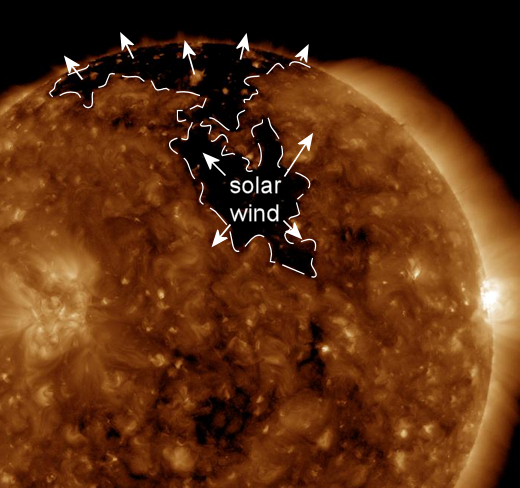
Because this hole is centered in the sun's northern hemisphere, the emerging stream of solar wind won't hit Earth directly. Instead, it will likely graze our planet's magnetic field--a geometry that can cause the magnetosphere to ring like a bell.
High-latitude sky watchers should be alert for auroras, especially in the southern hemisphere where deepening autumn darkness favors visibility of Southern Lights. Free: Aurora Alerts.
BASEBALLS IN THE STRATOSPHERE: Father's day is less than a month away. To get ready, the students of Earth to Sky Calculus have been launching baseballs to the edge of space. These unique balls traveled to the stratosphere onboard cosmic ray balloons and returned to Earth ready to be given as far-out gifts to Dad:

You can have one for $129.95. So far we have flown baseballs for the Dodgers, Red Sox, Giants, Angels, and Padres. If your home team is not on that list, let us know and we will fly it for you. Each baseball comes with a greeting card showing the ball in flight and telling the story of its journey to the stratosphere. All sales support atmospheric cosmic ray monitoring and hands-on STEM education.