DIPPING IN AND OUT OF THE SOLAR WIND: Earth is exiting a stream of solar wind that sparked auroras over the Canadian prairies on May 22nd. We won't have to wait long for more. Another stream of solar wind is approaching Earth, due to arrive on May 27-28th. The gaseous material is flowing from a northern hole in the sun's atmosphere, and could spark high-latitude auroras this weekend. Free: Aurora Alerts.

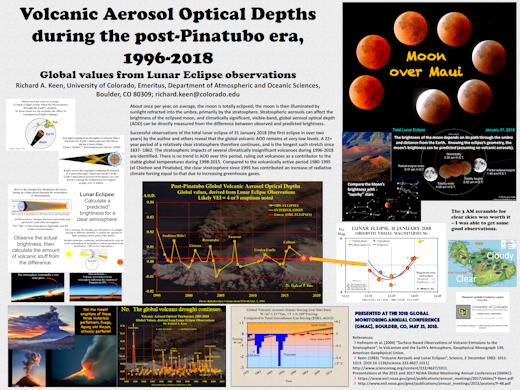
LUNAR ECLIPSES AND CLIMATE CHANGE: Strange but true: You can learn a lot about Earth's climate by watching a lunar eclipse. This week at the 46th Global Monitoring Annual Conference (GMAC) in Boulder, CO, climate scientist Richard Keen of the University of Colorado announced new results from decades of lunar eclipse monitoring.
"Based on the color and brightness of recent eclipses, we can say that Earth's stratosphere is as clear as it has been in decades. There are very few volcanic aerosols up there," he explains. This is important, climatologically, because a clear stratosphere "lets the sunshine in" to warm the Earth below.

To illustrate the effect that volcanic aerosols have on eclipses, Keen prepared a side-by-side comparison (above) of a lunar eclipse observed in 1992 after the Philippine volcano Pinatubo spewed millions of tons of gas and ash into the atmosphere vs. the latest "all-clear" eclipse in January 2018.
"Compared to the murky decades of the el Chichon and Pinatubo, the clear stratosphere since 1995 has allowed the intensity of sunlight reaching the ground to increase by about 0.6 Watts per square meter," says Keen. "That's equivalent to a warming of 1 or 2 tenths of a degree C (0.1 C to 0.2 C)."
"In other words," he adds, "over the past 40 years, the decrease of volcanic aerosols and the increase of greenhouse gases have contributed equally to the total warming (~0.3 C) observed in global satellite temperature records."
Total lunar eclipses happen somewhere on Earth typically once or twice a year. Keen is looking forward to the next one on July 27, 2018, which will be the longest lunar eclipse of the century. The Moon will pass almost directly through the middle of Earth's shadow, remaining inside for 1 hour and 43 minutes. That's just a few minutes shy of the theoretical maximum.
"This will give us plenty of time to measure the color and brightness of Earth's shadow and, thus, the aerosol content of the stratosphere," says Keen.
For more information about lunar eclipses and climate change, check out Keen's poster from the GMAC.
A CRYSTAL BALL IN THE STRATOSPHERE: Father's Day is less than a month away. To get ready, the students of Earth to Sky Calculus launched a crystal ball to the stratosphere. Watch the video as the crystal orb travels onboard a giant helium balloon 93,000 feet above Earth's surface, stretching, focusing, and inverting the incredible landscape of the Sierra Nevada mountains behind it:
The students are selling these crystal balls as a fundraiser, and you can have one for $229. The 800 gram sphere contains an embedded model of the Solar System, including the sun, eight planets and their moons. It makes an incredible gift for anyone interested in space. Dad-satisfaction guaranteed.
Each crystal ball comes with a unique gift card showing the item at the edge of space and telling the story of its flight. All proceeds support Earth to Sky Calculus and hands-on STEM research.
Far Out Gifts: Earth to Sky Store
All proceeds support hands-on STEM education
SOLAR MINIMUM SUNSPOTS: Lack of sunspots is a sign of Solar Minimum and for most of 2018 the face of the sun has been persistently blank. Today, Solar Minimum is taking the day off. Two sunspot groups are emerging on opposite sides of the sun:

Astronomers with safely-filtered solar telescopes are encouraged to train their optics on these regions. The one on the right is growing rapidly, while the one on the left is crackling with B- and C-class solar flares.
Such relatively weak flares would seldom be mentioned during Solar Max, but any flare is remarkable during the current period of deepening Solar Minimum. Since yesterday, Earth-orbiting satellites have detected almost two dozen minor eruptions. Their combined effect may be noticable to radio operators in the form of HF brownouts and other propagation effects. Stay tuned for updates.