CHANCE OF STORMS ON JUNE 1ST: A solar wind stream is heading for Earth, flowing from an equatorial hole in the sun's atmosphere. Estimated time of arrival: June 1st. G1-class geomagnetic storms and high-latitude auroras are possible when the gaseous material arrives. Free: Aurora Alerts.


WAITING FOR NOCTILUCENT CLOUDS: Every year in late May or early June, electric-blue noctilucent clouds (NLCs) begin to swirl around the Arctic Circle. Now is the time the clouds usually appear. So far, however, NASA's AIM spacecraft, which monitors NLCs, isn't seeing any. AIM's first polar image of the season (dated May 25th) shows no puffs of electric-blue:

"We expect to see NLCs appear any day now," says Cora Randall, AIM science team member at the University of Colorado. "Temperature and water vapor readings from NASA's MLS instrument suggest that conditions are right for the season to begin." Keep an eye out for the first clouds right here on Spaceweather.com.

Previous data from AIM have shown that NLCs are like a great "geophysical light bulb." They turn on every year in late spring, reaching almost full intensity over a period of 5 to 10 days. This means observers on the ground should soon begin to see them not long after AIM does.
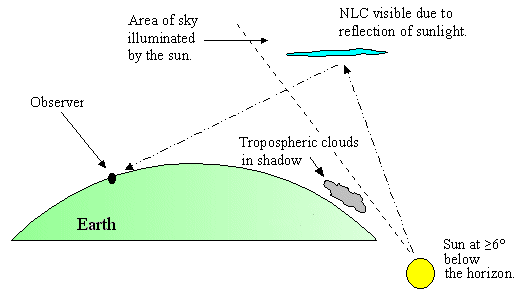
NLCs are Earth's highest clouds. Seeded by meteoroids, they float at the edge of space more than 80 km above the planet's surface. The clouds form when summertime wisps of water vapor waft up and crystallize around specks of meteor smoke.
Realtime Space Weather Photo Gallery
RADAR ECHOES FROM THE NOCTILUCENT ZONE: Every summer since the late 1970s, radars probing Earth's upper atmosphere have detected strong echoes from altitudes between 80 km and 90 km. This is the "noctilucent zone," a thin layer of air near the edge of space where water vapor crystallizes around meteor smoke to form icy noctilucent clouds (NLCs). NASA's AIM spacecraft is still waiting to spot the first NLCS of the 2018 season, but the radar echoes have already begun.
Les Dean of the MST Radar Facility in Aberystwyth, Wales, reports: "We detected our first echoes of the summer season on May 27th."

Researchers call them "Polar Mesospheric Summer Echoes" or "PMSEs." They occur over the Arctic during the months of May through August, and over the Antarctic during the months of November through February. These are the same months that NLCs appear.
The underlying physics of these echoes is still uncertain. A leading theory holds that the ice particles in noctilucent clouds are electrically charged, and this makes them good reflectors of HF radio waves. However, NLCs are not always visible when the radar echoes are observed and vice versa.
"They're not quite NLCs," says Dean, "but the first of this season's Polar Mesospheric Summer Echoes indicate NLCs will be around very soon."
Realtime Space Weather Photo Gallery
A BASEBALL IN THE STRATOSPHERE: Some home runs begin with the loud crack of a bat. This one began with a countdown: "10, 9, 8, 7...." On May 17, 2018, the students of Earth to Sky Calculus launched this Giants ball to the stratosphere on a cosmic ray balloon:

Riding alongside an array of radiation sensors, which the students use for atmospheric research, the commemorative baseball sailed 34.2 km (112,205 feet) above Earth's surface. Now that's a home run!
The students are selling these balls as a fundraiser. You can have one for $129.95. Each baseball comes with a greeting card showing the ball in flight and telling the story of its journey to the stratosphere. They make great Father's Day gifts.
Are you a fan of a different team? We also have "space balls" for the Angels, Red Sox, Dodgers, and Padres. Coming soon: Royals, Cubs, Yankees, Astros. If your home team is not on the list, let us know and we will fly it for you on an upcoming flight.
Far Out Gifts: Earth to Sky Store
All proceeds support hands-on STEM education