MIDNIGHT PLANET SHOW: Any night this week, step outside after midnight and look south. You'll see Jupiter, Saturn and Mars arranged in a bright line across the starry sky. The Moon can be your guide. It's hopping from one planet to the next with beautiful conjunctions on June 1st (Moon-Saturn) and especially June 3rd (Moon-Mars). Enjoy the show! Sky maps: May 31, June 1, 2, 3, 4.


CHANCE OF STORMS: NOAA forecasters say there is a 60% chance of G1-class geomagnetic storms on June 1st when a solar wind stream is expected to hit Earth's magnetic field. The gaseous material is flowing from an equatorial hole in the sun's atmosphere:


This is a coronal hole--a region where the sun's magnetic field has opened up, allowing solar wind to escape. It looks dark in this extreme UV image from NASA's Solar Dynamics Observatory because the hot gas normally contained there is missing. Soon it will be at Earth.
High-latitude sky watchers should be alert for auroras when the solar wind arrives, especially in the southern hemisphere where autumn darkness favors visibility. Free: Aurora Alerts.
BASEBALLS IN THE STRATOSPHERE: Some home runs begin with the crack of a bat. This one began with a countdown: "10, 9, 8, 7...." On May 23, 2018, the students of Earth to Sky Calculus launched this World Series Champion Houston Astros ball to the stratosphere on a cosmic ray balloon:

You can have it for $129.95. The students are selling these balls as a fundraiser for their cosmic ray ballooning. Each baseball comes with a greeting card showing the ball in flight and telling the story of its journey to the stratosphere. They make great Father's Day gifts.
Are you a fan of a different team? We also have "space balls" for the Red Sox, Angels, Dodgers, Giants, and Padres. Coming soon: Royals, Cubs, Yankees. If your home team is not on the list, let us know and we will fly it for you on an upcoming flight.
Far Out Gifts: Earth to Sky Store
All proceeds support hands-on STEM education
NOCTILUCENT CLOUD SEASON BEGINS: NASA's Aeronomy of Ice in the Mesosphere (AIM) spacecraft has spotted its first noctilucent clouds (NLCs) of the 2018 season. They are the electric-blue puffs circled in this image of the Arctic taken by AIM's CIPS instrument on May 27th:

"The summer season for noctilucent clouds has begun," says Cora Randall, AIM science team member at the University of Colorado. "We spotted the first hint of NLCs in our data on May 23rd; now they are brightening rapidly."
NLCs are Earth's highest clouds. Seeded by meteoroids, they float at the edge of space more than 80 km above the planet's surface. The clouds form when summertime wisps of water vapor waft up and crystallize around specks of meteor smoke.
Previous data from AIM have shown that NLCs are like a great "geophysical light bulb." They turn on every year in late spring, reaching almost full intensity over a period of 5 to 10 days. This means observers on the ground could begin to see them not long after AIM does. Here is what a well-developed display of NLCs looks like, photographed on August 5, 2017, by Catalin Tapardel in Alberta, Canada:

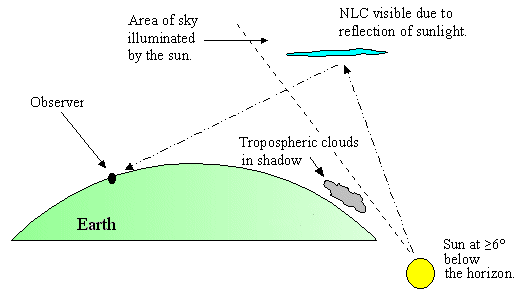
Early-season NLCs are usually faint and always found in high latitude places such as Canada, the British isles, Siberia and Scandinavia. To people in those areas, we offer the following observing tips: Look west 30+ minutes after sunset when the sun has dipped 6o or more below the horizon. If you see luminous blue-white tendrils spreading across the sky, you may have spotted a noctilucent cloud.