MOON-MARS CONJUNCTION: Wide awake at 3 am? Go outside and look south. The Moon and Mars are having a beautiful conjunction in the constellation Capricornus this weekend. For a special treat, try to catch them during the hour before sunrise. Twilight blue brings out the red in Mars. Sky maps: June 3, 4.


THE EPICENTER OF 'SPRITE ALLEY': Oklahoma is a good place to see sprites. "I photograph them often," says Paul Smith of Edmond OK. "Here are some examples from May 30th flashing above fast-moving storms in the Oklahoma panhandle."
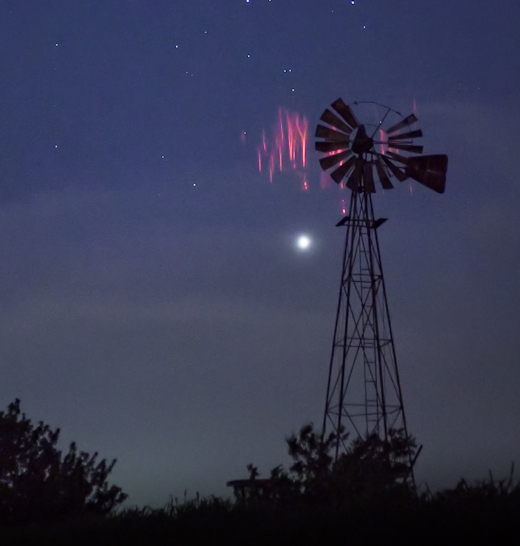
"Venus is the bright 'star' just behind the windmill," he adds.
Oklahoma is the epicenter of a region that we call "Sprite Alley," a corridor stretching across the US Great Plains where intense thunderstorms produce lots of upward directed lightning--a.k.a. "sprites."
"I have been recording sprites since last summer when I accidentally caught a few during the Perseid meteor shower," says Smith. "I now have a couple of hundred events on camera and I am out almost every night there are storms in my vicinity."
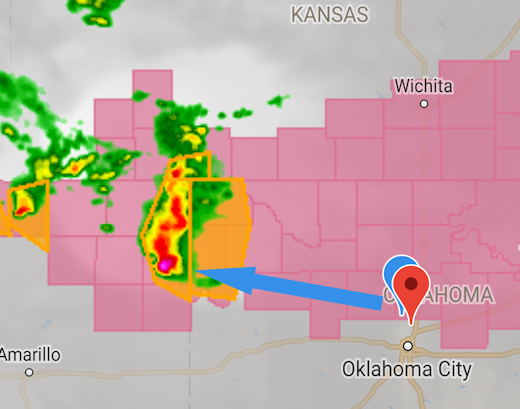
The blue pushpin in the satellite weather map, above, shows Smith's location. The blue arrow points to the storm cell that produced the sprites.
People have been seeing sprites since at least the 19th century, but those early reports were often met with skepticism. Sprites entered the mainstream in 1989 when researchers from the University of Minnesota finally captured them on film. Subsequent video footage from the space shuttle cemented their status as an authentic physical phenomenon.
In recent years, citizen scientists have been photographing sprites in record numbers. But why? It could be a result of raised awareness. More photographers know about sprites, so naturally more sprite photos are taken. There might also be a real increase in sprite activity. Some researchers think that sprites are linked to cosmic rays: Subatomic particles from deep space strike the top of Earth's atmosphere, producing secondary electrons that trigger the upward bolts. Indeed, cosmic rays are now intensifying due to the decline of the solar cycle.
It all adds up to more sprites over Oklahoma. More examples may be found on Paul Smith's Facebook page.
A CRYSTAL BALL IN THE STRATOSPHERE: Father's Day is less than a month away. To get ready, the students of Earth to Sky Calculus launched a crystal ball to the stratosphere. Watch the video as the crystal orb travels onboard a giant helium balloon 93,000 feet above Earth's surface, stretching, focusing, and inverting the incredible landscape of the Sierra Nevada mountains behind it:
The students are selling these crystal balls as a fundraiser, and you can have one for $229. The 800 gram sphere contains an embedded model of the Solar System, including the sun, eight planets and their moons. It makes an incredible gift for anyone interested in space. Dad-satisfaction guaranteed.
Each crystal ball comes with a unique gift card showing the item at the edge of space and telling the story of its flight. All proceeds support Earth to Sky Calculus and hands-on STEM research.
Far Out Gifts: Earth to Sky Store
All proceeds support hands-on STEM education
NOCTILUCENT CLOUDS INTENSIFY OVER EUROPE: NASA's AIM spacecraft is seeing electric-blue noctilucent clouds spread across the Arctic Circle. Observers on the ground are beginning to see them, too. This weekend we've received reports of sightings from Scotland, Norway, Denmark, and possibly England. John C McConnell sends this photo of the telltale blue ripples from Maghaberry Northern Ireland:
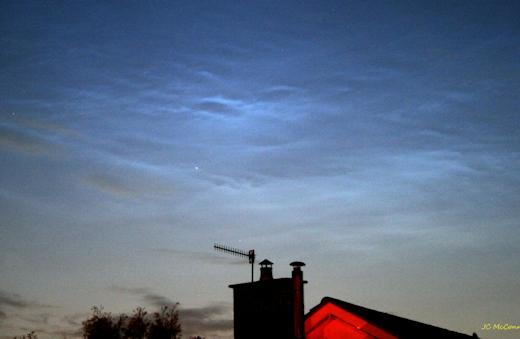
"These were our first NLCs of the summer season," says McConnell. "The display was quite extensive across the northern sky with some nice wave structure."
What are NLCs? You can think of them as frosted meteoroids. Noctilucent clouds form when summertime wisps of water vapor waft up to the top of Earth's atmosphere and crystallize around specks of meteor smoke. The resulting swarms of tiny ice crystals glow electric blue when struck by high altitude sunlight.
These displays should increase in the nights ahead. Previous data from AIM have shown that NLCs are like a great "geophysical light bulb." They turn on every year in late spring, reaching almost full intensity over a period of 5 to 10 days. Soon the ripples people are seeing in Northern Europe should intensify and spread, forming electric-blue waves that glow deep into the night.