EXITING THE SOLAR WIND STREAM: Earth is exiting a stream of solar wind that sparked G1-class geomagnetic storms and apparitions of STEVE during the weekend. NOAA forecasters have reduced the chance of additional storms on June 4th to 25% as the solar wind speed subsides. Free: Aurora Alerts.


SMALL ASTEROID HITS EARTH: On Saturday, June 2nd, astronomers working with the Catalina Sky Survey in Arizona discovered a small asteroid (2018 LA) near the orbit of the Moon. Hours later, it hit Earth. The boulder-sized space rock entered the atmosphere traveling 38,000 mph (17 km/s) and exploded over Botswana at 6:44 p.m. local time. A video camera at a farm near Ottosda, South Africa, recorded the explosion. It was impressively bright even at a distance:
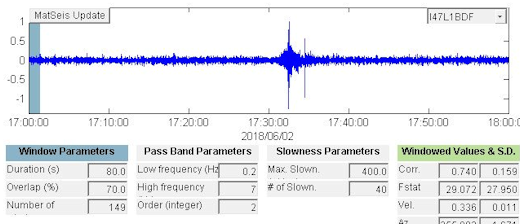
The explosion sent waves of low-frequency sound (infrasound) rippling through the atmosphere, and it was detected by an infrasound monitor in South Africa, deployed as part of the International Monitoring System of the Comprehensive Nuclear-Test-Ban Treaty. Meteor expert Peter Brown of the University of Western Ontario analyzed the signals and came to these conclusions about the explosion:
"The yield was in the range 0.3 to 0.5 kilotons of TNT," he says. "That corresponds to a 2 meter diameter asteroid."
As asteroids go, that's very small. It posed no significant danger to objects on the ground as it disintegrated almost wholly in the atmosphere. Fragments may yet be found on the ground and recovered for sale or scientific study.
The real significance of this event is that it highlights the growing capability of modern sky surveys to discover asteroids targeting Earth. Even small faint space rocks are being caught in the net. Boulder-sized impactors have been discovered hurtling toward Earth three times in the past 10 years: 2008 TC3 exploded over northern Sudan on Oct. 7, 2008; 2014 AA burned up above the Atlantic Ocean on Jan. 1, 2014; and now 2018 LA. In each case, the warning was less than a day. Larger asteroids may be seen at a greater distance, however, allowing for more lead time. Learn more about the latest impact from NASA.
Realtime Space Weather Photo Gallery
A CRYSTAL BALL IN THE STRATOSPHERE: Father's Day is less than two weeks away. To get ready, the students of Earth to Sky Calculus launched a crystal ball to the stratosphere. Watch the video as the crystal orb travels onboard a giant helium balloon 93,000 feet above Earth's surface, stretching, focusing, and inverting the incredible landscape of the Sierra Nevada mountains behind it:
The students are selling these crystal balls as a fundraiser, and you can have one for $229. The 800 gram sphere contains an embedded model of the Solar System, including the sun, eight planets and their moons. It makes an incredible gift for anyone interested in space. Dad-satisfaction guaranteed.
Each crystal ball comes with a unique gift card showing the item at the edge of space and telling the story of its flight. All proceeds support Earth to Sky Calculus and hands-on STEM research.
Far Out Gifts: Earth to Sky Store
All proceeds support hands-on STEM education
NOCTILUCENT CLOUDS INTENSIFY OVER EUROPE: NASA's AIM spacecraft is seeing electric-blue noctilucent clouds (NLCs) spread across the Arctic Circle. Observers on the ground are beginning to see them, too. Over the weekend we received reports of sightings from England, Scotland, Norway, Northern Ireland--and this incredible shot from Denmark:
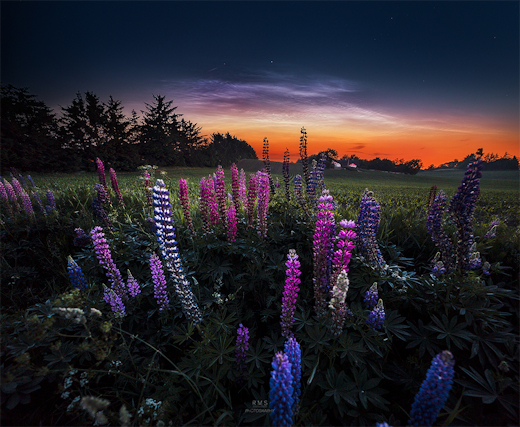
"The noctilucent clouds were intense over Northern Jutland on June 3rd," says photographer Ruslan Merzlyakov. "I was totally amazed, how bright they were compared to their first appearance just 3 days earlier."
What are NLCs? You can think of them as frosted meteoroids. Noctilucent clouds form when summertime wisps of water vapor waft up to the top of Earth's atmosphere and crystallize around specks of meteor smoke. The resulting swarms of tiny ice crystals glow electric blue when struck by high altitude sunlight.
These displays should increase in the nights ahead. Previous data from AIM have shown that NLCs are like a great "geophysical light bulb." They turn on every year in late spring, reaching almost full intensity over a period of 5 to 10 days. Soon the ripples people are seeing in Northern Europe should intensify and spread, forming electric-blue waves that glow deep into the night.