SPACE WEATHER VS. SUPERCOMPUTERS: Solar minimum is coming. Should supercomputers worry? Researchers have long known that cosmic ray neutrons and other high energy particles can cause errors and even crash supercomputers in mid-calculation. That's worrisome because cosmic rays are intensifying with the decline of the sunspot cycle. Hewlett-Packard is even testing a supercomputer on the International Space Station to see how cosmic rays affect it. Improved shielding and error-correcting codes may yet solve the problem. Meanwhile, stay tuned for ... <glitch> ... solar minimum.
NOCTILUCENT CLOUDS SPREADING ACROSS THE ARCTIC: High above the Arctic Circle at the edge of space, electric-blue noculucent clouds (NLCs) are filling the sky. Since NASA's AIM spacecraft spotted the first wisps of NLCs on May 23rd, the areal coverage of the clouds has multiplied more than 100-fold. This animation of AIM data shows their progression over the last 5 days:

This explosion of cloudiness comes as no surprise. Previous data from AIM have shown that NLCs are like a great "geophysical light bulb." They turn on every year in late spring, reaching almost full intensity over a period of 5 to 10 days.
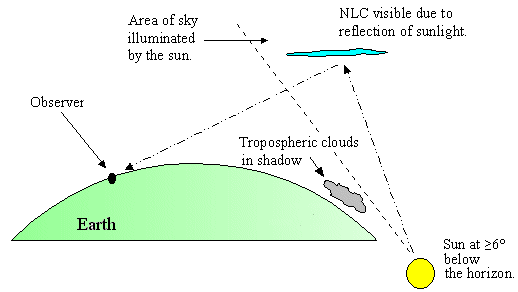
What are NLCs? You can think of them as frosted meteoroids. Noctilucent clouds form when summertime wisps of water vapor waft up to the top of Earth's atmosphere and crystallize around specks of meteor smoke. The resulting swarms of tiny ice crystals glow electric blue when struck by high altitude sunlight--often shining deep into the night at the sub-Arctic latitudes.
Observing tips: Look west ~30 minutes after sunset when the sun has dipped ~6 degrees below the horizon. If you see luminous blue-white tendrils spreading across the sky, you may have spotted a noctilucent cloud.
"FLY ME TO THE MOONSTONE" PENDANT: Are you looking for a far out gift? Consider this: The students of Earth to Sky Calculus have flown a moonstone pendant to the edge of space onboard a cosmic ray balloon. Here it is 115,158 feet above Earth's surface:

The students are selling these pendants as a fundraiser for their radiation monitoring program. You can have one for $179.95. Hand-crafted in the shape of a Celtic love knot, each sterling silver premium pendant comes with a greeting card showing the jewelry in flight and telling the story of its journey to the edge of space.
Far Out Gifts: Earth to Sky Store
All proceeds support hands-on STEM education