SPACE WEATHER VS. SUPERCOMPUTERS: Solar minimum is coming. Should supercomputers worry? Researchers have long known that cosmic ray neutrons and other high energy particles can cause errors and even crash supercomputers in mid-calculation. That's worrisome because cosmic rays are intensifying with the decline of the sunspot cycle. Hewlett-Packard is even testing a supercomputer on the International Space Station to see how cosmic rays affect it. Improved shielding and error-correcting codes may yet solve the problem. Meanwhile, stay tuned for ... <glitch> ... solar minimum.
A SUNSPOT NAMED "HUBBLE": For a split second on June 1st, the sunspot number doubled. Michael Marston of Brisbane, Australia, was rolling his video camera as a tiny black speck raced across the sun, almost skimming sunspot group AR2712. The extra "sunspot" was the Hubble Space Telescope:

"Hubble is only about the size of a bus, and it was extremely far away, but it was visible to my video camera running at 60 frames per second," says Marston. "Given the Sun is so bright, I couldn't see anything with my unaided eye. I didn't dare look directly into the Sun, so I used a clock and timing to capture the transit."
He knew when to trigger the recording thanks to Calsky.com, which predicts transits of the HST across the sun and Moon. "I got the prediction about a week ahead of time," he says. Not long after the transit, the real sunspot AR2712 began to dissolve now. It's gone now, but Hubble is still there. Check it out.
WE'RE GOING TO NEW ZEALAND: For the past two years, Spaceweather.com and the students of Earth to Sky Calculus have been traveling around the world, launching cosmic ray balloons to map our planet's radiation environment. We've sampled deep space radiation over Sweden, Mexico, Norway, Chile and almost a dozen US states. This month we're adding New Zealand to the list. On June 18th, a team of 11 Earth to Sky students and two mentors will fly from California to the north island of New Zealand, where we will launch 3 research balloons in only 10 days.

Our hosts are Terry and Linda Coles of Enternet Online Limited (EOL), a leading New Zealand internet service provider based in Tauranga. EOL has been a supporter of Earth to Sky Calculus for many years. They sponsored one of our earliest balloon launches in 2013 when we flew their mascot, EVA the Cow, to the stratosphere. While we are in New Zealand, they will be donating all of our lodging and transportation. Thanks again, EOL!
Not only will we be measuring cosmic rays, but also we will train New Zealand students to launch balloons, hopefully kickstarting a STEM balloon program in the southern hemisphere. Five schools are participating: 1. Mount Maunganui College; 2. Otumoetai College; 3. Tauranga Girls College; 4. Tauranga Boys College; and 5 Bethlehem College. Some of those schools will be sending their own experiments to the stratosphere alongside Earth to Sky radiation sensors.
We can't wait to get to New Zealand and share our adventure. Stay tuned for more information about what we hope to learn about cosmic rays by visiting the 8th continent.
Realtime Space Weather Photo Gallery
THE SPACE HAMMER FOR FATHER'S DAY: Just in time for Father's Day: The Space Hammer. On June 2nd, the students of Earth to Sky Calculus flew a payload of hammers to the edge of space, 35.0 km (115,000 feet) above Earth's surface on board a high altitude helium balloon. You can have one for $97.95:
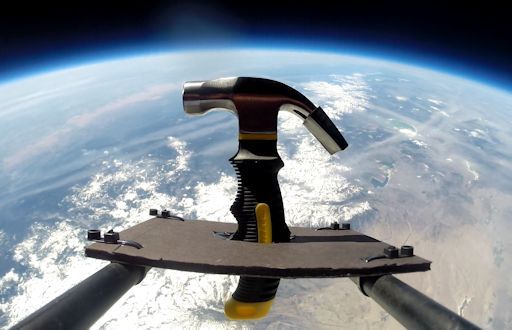
These compact 8 oz. hammers are light enough to fly on a balloon yet dense enough to deliver a powerful blow. The magnetic head holds a nail for one-handed starting, and the stubby 6 in. length is perfect for tight work areas.
Each space hammer comes with a unique gift card showing the tool floating at the top of Earth's atmosphere. The interior of the card tells the story of the flight and confirms that this gift has been to the edge of space and back again.
Far Out Gifts: Earth to Sky Store
All proceeds support hands-on STEM education