DAYTIME METEOR SHOWER: One of the most active meteor showers of the year is peaking today, June 7th. You can't see it though. The Arietid meteor shower happens in broad daylight. If you could turn off the midday sun, you would see about 60 meteors per hour streaking out of the constellation Aries. No one is sure where Arietid meteoroids come from. Some astronomers suspect they are debris from sungrazing asteroid 1566 Icarus. Another candidate is comet 96P/Machholz. Browse: Meteor Photo Gallery.
RED RAINBOW SPOKE: We all know two things about rainbows: 1. They are circular. 2. They are multicolored. Yet on June 5th, Michelle Shenberger of Dover, Pennsylvania, saw a rainbow that was neither. "It was weird," she says. "The rainbow was only red, and mostly horizontal."

Yes, this *is* a rainbow--a red rainbow spoke.
What made it red? Red was only color available. All of the other colors of the rainbow had been scattered away by air molecules and dust particles in front of the low-hanging sun. Sunset rainbows are often red like this.
Normally, red rainbows form a complete arc. This one, however, was interrupted by clouds. Shadows of clouds near the setting sun stretched across the sky, extinguishing most of the rainbow. Only a single almost-horizontal spoke remained. Weird, indeed.
Realtime Space Weather Photo Gallery
FATHER'S DAY SPECIAL: What do you get for the Dad who has everything? He probably doesn't have this: A 3D Moon globe laser-etched inside a crystal cube. And, oh yes, it has been to the edge of space:
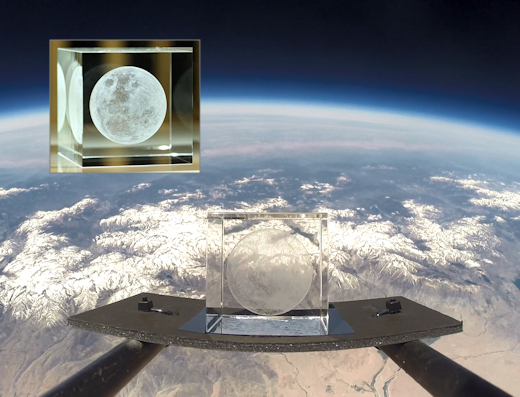
The students of Earth to Sky Calculus flew a payload-full of these unique cubes to the stratosphere on June 3rd. You can have one for $149.95. They're selling them as a fund-raiser for their cosmic ray ballooning program.
Each Moon-cube comes with a unique gift card showing the item floating at the top of Earth's atmosphere. The interior of the card tells the story of the flight and confirms that this gift has been to the edge of space and back again. Dad-satisfaction guaranteed.
Far Out Gifts: Earth to Sky Store
All proceeds support hands-on STEM education
WHAT IS THE REGENER-PFOTZER MAXIMUM? About once a week, Spaceweather.com and the students of Earth to Sky Calculus launch a helium balloon with radiation sensors to the stratosphere over California. This is a unique monitoring program aimed at tracking the cosmic ray situation in Earth's atmosphere. During each flight, our balloon passes through something called the Regener-Pfotzer Maximum, a layer of peak radiation about 20 km above Earth's surface. This plot of radiation vs. time taken during a typical balloon flight illustrates the peak.

Ref: Phillips, T., et al. (2016), Space Weather Ballooning, Space Weather, 14, 697–703, doi: 10.1002/2016SW001410.
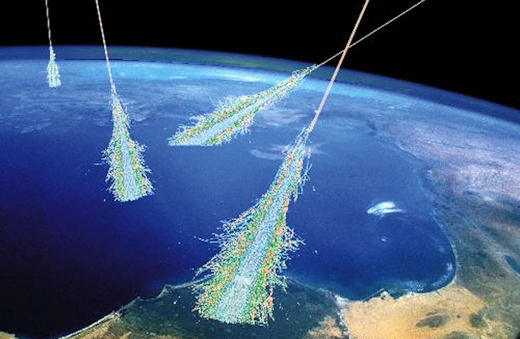
What is this peak? To understand it, let us begin in deep space. Cosmic rays are, essentially, the subatomic debris of dying stars, accelerated to nearly light speed by supernova explosions. They travel across space and approach Earth from all directions, peppering our planet 24/7. When cosmic rays crash into Earth's atmosphere, they produce a spray of secondary particles and photons that is most intense at the entrance to the stratosphere. Physicists Eric Regener and Georg Pfotzer discovered the maximum using balloons in the 1930s and it is what we are measuring today.
In some ways, secondary cosmic rays are like froth on the ocean. By watching the froth, you can learn a lot about the underlying water. Likewise, by watching secondary cosmic rays, we learn a lot about primary cosmic rays hitting the top of the atmosphere. Indeed, our balloon measurements have recently confirmed what NASA spacecraft are finding: The cosmic ray situation is worsening.
For many years, the Regener-Pfotzer Maximum was called, simply, the "Pfotzer Maximum." Regener's name is less recognized by present-day physicists largely because in 1937 he was forced to take early retirement by National Socialists as his wife had Jewish ancestors. This interesting story weaving science, politics, and human nature has recently been told by historians of science P. Carlson and A. A. Watson. Ref: Hist. Geo Space. Sci., 5, 175-182, 2014.
Technical note: The radiation sensors onboard our helium balloons detect X-rays and gamma-rays in the energy range 10 keV to 20 MeV. These energies span the range of medical X-ray machines and airport security scanners.