QUIET WITH A SLIGHT CHANCE OF STORMS: Earth's magnetic field is quiet as our planet moves through a region of calm solar wind. Activity could increase on June 12th or 13th, however, when Earth enters a solar wind stream flowing from a small hole in the sun's atmosphere. NOAA forecasters say there is a 25% chance of minor geomagnetic storms. Free: Aurora Alerts.
SPRITE LIGHTNING STORM OVER EUROPE: This weekend, a powerful mesoscale convective system (MSC) of thunderstorms over central Europe produced a furious outburst of sprites. "It was unreal," says Martin Popek of Nýdek, Czechia, a veteran photographer of the upward directed bolts. "I recorded more than 250 sprites in only 4.5 hours of observation! That's nearly as many as I typically see in the entire summer thunderstorm season."
Many of the sprites during the outburst looked like this:
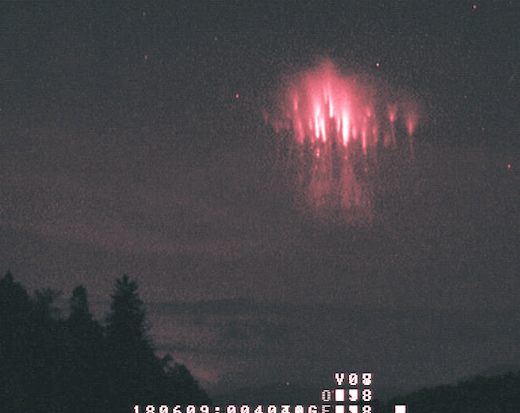
This is a jellyfish sprite--so called because it resembles the eponymous sea creature. Jellyfish sprites are typically very large, stretching as much as 50 km between the tops of their heads to the tips of their tentacles below. "Regular jellyfish sprites are associated with very strong positive cloud-to-ground lightning strokes in the underlying convective storms," notes lightning scientist Oscar van der Velde of the Technical University of Catalonia, Spain.
However, not all of the jellyfish were regular. Some were "decapitated"--without heads. "I recorded about 20 sets of tentacles only," says Popek. Here is one example of many:


"In my experience, this is quite rare," he adds.
"It is rare," agrees van der Velde. "We don't know why they sometimes look like this." He speculates that atmospheric waves called "gravity waves" sometimes interfere with the normal formation of jellyfish, leaving them headless. "Mesospheric gravity waves likely help focus the electric field to trigger downward streamers," he says. "But note that sprite morphology is not fully understood--not even for regular jellyfish. We have a lot to learn."
Another observer in the Czech Republic, Daniel Ščerba-Elza, also photographed the display. "It was extremely active," says Ščerba-Elza. "I recorded about 69 sprites, much more than usual. The storms were about 250 - 300 km away in Austria and Hungary. This is a good distance because it allows you to see over the tops of the thunderheads." He made a summary video of the outburst.
Such an outburst before summer even begins may be a good omen for sprite photographers as thunderstorm season gains steam. Stay tuned for more sightings.

FATHER'S DAY SPECIAL: What do you get for the Dad who has everything? He probably doesn't have this: A 3D Moon globe laser-etched inside a crystal cube. And, oh yes, it has been to the edge of space:
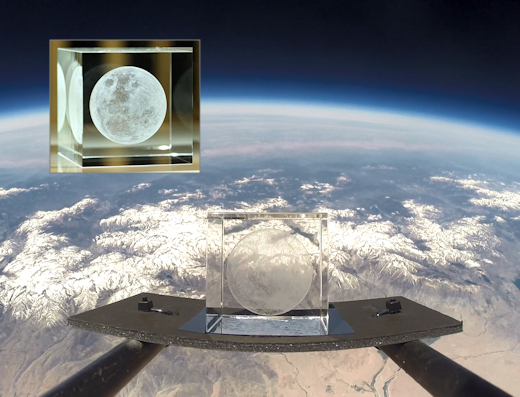
The students of Earth to Sky Calculus flew a payload-full of these unique cubes to the stratosphere on June 3rd. You can have one for $149.95. They're selling them as a fund-raiser for their cosmic ray ballooning program.
Each Moon-cube comes with a unique gift card showing the item floating at the top of Earth's atmosphere. The interior of the card tells the story of the flight and confirms that this gift has been to the edge of space and back again. Dad-satisfaction guaranteed.
Far Out Gifts: Earth to Sky Store
All proceeds support hands-on STEM education
GLOBAL COSMIC RADIATION MEASUREMENTS: For the past two years, Spaceweather.com and the students of Earth to Sky Calculus have been traveling around the world, launching cosmic ray balloons to map our planet's radiation environment. Our sensors travel from ground level to the stratosphere and bring their data back to Earth by parachute. Here is a plot showing radiation vs. altitude in Norway, Chile, Mexico, and selected locations in the USA:

Note: Data from Sweden and several other US states are omitted for the clarity of the plot.
We're about to add a new country to the list: New Zealand. On June 18th, a team of students from Earth to Sky is traveling to New Zealand's north island to launch 3 cosmic ray balloons in only 10 days. Soon, we will know more about cosmic rays above Earth's 8th continent.
Cosmic rays are, essentially, the subatomic debris of dying stars, accelerated to nearly light speed by supernova explosions. They travel across space and approach Earth from all directions, peppering our planet 24/7. When cosmic rays crash into Earth's atmosphere, they produce a spray of secondary particles and photons that is most intense at the entrance to the stratosphere. This secondary spray is what we measure.
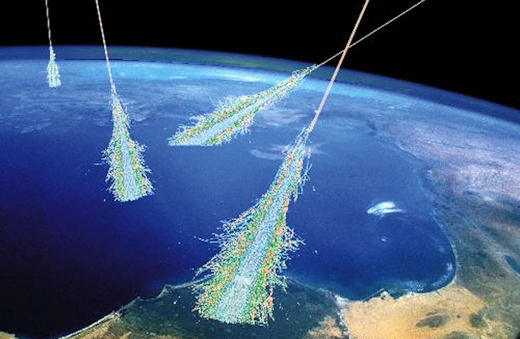
The purpose of our mapping project is to study how well Earth's atmosphere and magnetic field protects us from cosmic rays. As the plot shows, the shielding is uneven. More radiation gets through to the poles (e.g., Norway) and less radiation penetrates near the equator (e.g., Mexico).
But there's more to the story. Our launch sites in Chile and California are equidistant from the equator, yet their radiation profiles are sharply different. Chile is on the verge of the South Atlantic Anomaly, which almost surely distorts the radiation field there. Our flights over New Zealand may shed some light on this, because our launch sites in New Zealand will be the same distance from the equator as the sites in Chile. Stay tuned!
Technical note: The radiation sensors onboard our helium balloons detect X-rays and gamma-rays in the energy range 10 keV to 20 MeV. These energies span the range of medical X-ray machines and airport security scanners.