SOLAR WIND FAILS TO DISTURB QUIET: Earth is entering a minor stream of solar wind, which is increasing pressure on our planet's magnetic field. So far, however, this interaction is doing little to spark geomagnetic storms. The current spell of magnetic quiet should continue for the rest of the week. Free: Aurora Alerts.


HUGE DUST STORM ON MARS: Mars rover Opportunity is in trouble. NASA engineers attempted to contact Opportunity yesterday, June 12th, but did not hear back from the nearly 15-year old rover. The problem: A huge dust storm is blanketing Perseverance Valley where Opportunity has been working. This sequence of images from NASA's Mars Reconnaisance Orbiter shows the progression of the storm:

The huge dust cloud is highlighted in red. Soon after it appeared on May 31st, it swirled south to envelope Opportunity. Right now, the dust is so thick in Perseverance Valley, day has been turned into night. The solar powered rover is being deprived of the sunlight it needs to charge its batteries.
NASA is now operating under the assumption that the charge in Opportunity's batteries has dipped below 24 volts and the rover has entered low power fault mode, a condition where all subsystems, except a mission clock, are turned off. The rover's mission clock is programmed to wake Opportunity at intervals so it can check power levels. If the batteries don't have enough charge, the rover will put itself back to sleep again.
In a teleconference today, NASA planners expressed optimism that Opportunity can weather this storm and wake up again after the skies clear. It may take days or weeks for this to occur, however.
This is a dust storm of rare size. It is now on the verge of circumnavigating the entire globe, overlying more than a quarter of Mars' land area. It is so large, astronomers can photograph it using amateur telescopes. Indeed, Joseph Rueck saw the storm starting on May 31st using his backyard telescope in Seastian, Florida.
ONE RING TO RULE THE STRATOSPHERE: The students of Earth to Sky Calculus are about to fly from California to New Zealand to launch a trio of cosmic ray balloons over Earth's 8th continent. To get ready, yesterday they launched a ring of power to the stratosphere. Here it is floating 33 km above the Sierras of California:

You can have one for $119.95. The students are selling these Tolkien-inspired rings as a fundraiser for their trip. They are made of golden-colored tungsten and inscribed with the authentic Mordor script of the One Ring.
Buy one now, and we will fly it again for you over Hobbiton, located in the North Island of New Zealand where our cosmic ray balloons will be released. Just note "Please fly it again!" in the comments section at checkout.
Each golden ring comes with a greeting card showing the ring in flight and telling the story of its journey to the edge of space. Sales support the Earth to Sky Calculus cosmic ray ballooning program and hands-on STEM research.
Far Out Gifts: Earth to Sky Store
All proceeds support hands-on STEM education
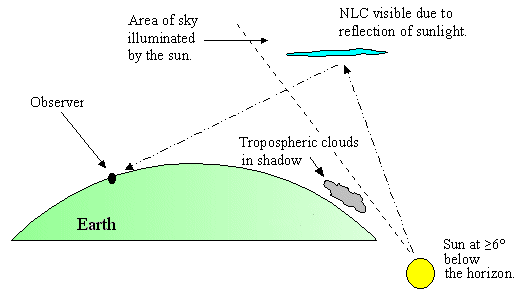
NOCTILUCENT CLOUDS INTENSIFY: Think of them as frosted meteoroids. Noctilucent clouds (NLCs) form when summertime wisps of water vapor rise to the top of Earth's atmosphere and wrap themselves around specks of meteor smoke. Winds in the mesosphere gather the resulting ice crystals into luminous filaments that glow electric-blue in the night sky ... like these:

Jüri Voit took the picture this morning, June 13th, just before sunrise in Kuusalu, Estonia. "This was my first sighting of NLCs this summer," says Voit. "I did not expect them to be so big and bright."
NASA's AIM spacecraft is tracking the formation of NLCs around the Arctic Circle. They're intensifying. Last night alone the electric-blue clouds were seen in Estonia, Belarus, Finland, Poland, Sweden, and Canada.
When noctilucent clouds first appeared in the 19th century, you had to travel to Arctic latitudes to see them. In recent years, however, they have spread with sightings as far south as Colorado and Kansas. Observing tips: Look west 30 to 60 minutes after sunset when the sun has dipped ~10 degrees below the horizon. If you see luminous blue-white tendrils spreading across the sky, you may have spotted a noctilucent cloud.