VENUS AND THE MOON: When the sun goes down tonight, step outside and look west. A slender crescent Moon is approaching Venus in the sunset sky. Catch them, if you can, before the sky fades to black. A Venus-Moon conjunction framed by twilight blue is extra beautiful. Sky maps: June 15, 16.


NIGHT SHINING CLOUDS: When the sun goes down, the sky is supposed to fade to black. However, that's not what happened on June 13th when the sun went down in Belarus. "There was a noctilucent (night-shining) cloud over Minsk," reports Yauhen Petruchenia. "The bright glow lasted almost all night long, from midnight through 3 am."

Noctilucent clouds (NLCs) are, essentially, frosted meteoroids. They form when summertime wisps of water vapor rise to the top of Earth's atmosphere and wrap themselves around specks of meteor smoke. Winds in the mesosphere gather the resulting ice crystals into rippling filaments, as shown above.
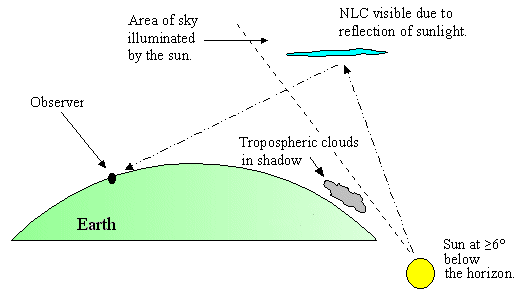
Noctilucent clouds float ~83 km above Earth's surface--so high that sunlight can hit them even when it is dark on the ground below. The sky can't fade to black when NLCs are around.
When noctilucent clouds first appeared in the 19th century, you had to travel to Arctic latitudes to see them. In recent years, however, they have spread with sightings as far south as Colorado and Kansas. Observing tips: Look west 30 to 60 minutes after sunset when the sun has dipped ~10 degrees below the horizon. If you see luminous blue-white tendrils spreading across the sky, you may have spotted a noctilucent cloud.
Realtime Noctilucent Cloud Photo Gallery
ONE RING TO RULE THE STRATOSPHERE: The students of Earth to Sky Calculus are about to fly from California to New Zealand to launch a trio of cosmic ray balloons over Earth's 8th continent. To get ready, on June 12th they launched a ring of power to the stratosphere. Here it is floating 33 km above the Sierra Nevada mountains of central California:

You can have one for $119.95. The students are selling these Tolkien-inspired rings as a fundraiser for their trip. They are made of golden-colored tungsten and inscribed with the authentic Mordor script of the One Ring.
Buy one now, and we will fly it again for you over Hobbiton, located in the North Island of New Zealand where our cosmic ray balloons will be released. Just note "Please fly it again!" in the comments section at checkout.
Each golden ring comes with a greeting card showing the ring in flight and telling the story of its journey to the edge of space. Sales support the Earth to Sky Calculus cosmic ray ballooning program and hands-on STEM research.
Far Out Gifts: Earth to Sky Store
All proceeds support hands-on STEM education
CZECHIA, THE LAND OF SPRITES: In the USA, Oklahoma is at the epicenter of "Sprite Alley"--a great place to see upward directed lightning as intense thunderstorms roll by. Europe has its own epicenter for sprites: Czechia. Observers there have recently recorded hundreds of sprites lancing up from storms in Austria, Poland and Hungary. Daniel Šcerba-Elza photographed these specimens on June 11th:

"The sprites were rising above a storm in Poland, about 100 km - 150 km away from my camera in Opava, Czechia," says Šcerba-Elza.
When it comes to photographing sprites, distance is a good thing. It allows the camera to see over the tops of towering thunderheads. Most sprites are photographed from 250 km to 300 km away, so Šcerba-Elza's capture at ~100 km may be considered point-blank range.

"I have been monitoring sprites regularly since 2016," says Šcerba-Elza, "and this has been an extremely active season."
If you would like to photograph some sprites yourself, just read "The Red Sprite Manual." It is written in, you guessed it, Czech.