SLIGHT CHANCE OF FLARES: NOAA forecasters say there is a slight 5% chance of M-class solar flares today. The source would be big sunspot AR2715. Because AR2715 is almost directly facing Earth, any explosions would be geoeffective, possibly causing shortwave radio blackouts and minor geomagnetic storms. Free: Aurora Alerts.
SPACE WEATHER BALLOONS OVER NEW ZEALAND: On June 21st, the first day of winter in the southern hemisphere, Spaceweather.com and Earth to Sky Calculus launched two space weather balloons from New Zealand. It was a wonderful day as our California students worked closely with students from Mount Maunganui College and Otumoetai College to prepare the payloads and launch the balloons. In addition to our usual radiation sensors, the balloons carried experiments designed by local New Zealand students as well--one of them a robot programed to expose microbes to the environment of the stratosphere.

Only one bit of bad news marred the day: The second balloon we launched sailed into the Bay of Plenty and was lost along with a full complement of X-ray, gamma-ray, and neutron sensors.
On the bright side, the first balloon landed short of the beach and was recovered by a joint team of students from Earth to Sky and Otumoetai College. It was damp but intact--a complete success.
Flying balloons in a new country is always a learning experience. Telemetry from the lost payload given us important information about how to predict flight paths through the high atmosphere of Earth's 8th continent, and we will be launching another balloon tomorrow. Stay tuned!
A SPRITE SEEN FROM 35,000 FEET: Pilot Brian Whittaker has spent thousands of hours flying back and forth to London from the USA, and he has seen countless wonders of the night sky through the glass of the cockpit. This week for the first time, he photographed a sprite:
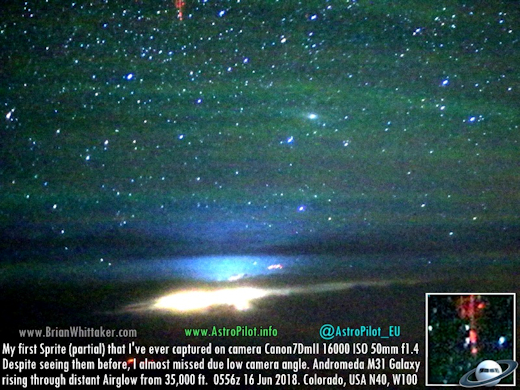
"I was very excited to finally photograph a sprite on the American Plains!" says Whittaker. "On June 16th, I was flying from Las Vegas to London when we flew by several very active thunderclouds. I had a prolonged view of countless rapid lightning flashes. This sprite leaped up from one of the thunderclouds."
The green bands in Whittaker's image are not auroras, but rather airglow. Airglow is caused by an assortment of chemical reactions in Earth's upper atmosphere. These reactions get started during daylight hours when the atmosphere is bathed in strong UV radiation from the sun. Sometimes, on dark nights, the green afterglow is visible, colored green by oxygen atoms 90-100 km high. Airglow occurs just above the altitude of most sprites.
"Sprites are really high up!" says Whittaker. "I wonder how many earlier sprites I've missed over the years because my camera was set just a little too low?"
Indeed. Summer is the season for sprites, and a good time for photographers to point their optics high, over the tops of towering thunderheads. Here's how.

Realtime Space Weather Photo Gallery
ONE RING TO RULE THE STRATOSPHERE: Today, the students of Earth to Sky Calculus are in New Zealand preparing to launch a trio of cosmic ray balloons over Earth's 8th continent. But first... on June 12th they launched a ring of power to the stratosphere. Here it is floating 33 km above the Sierra Nevada mountains of central California:
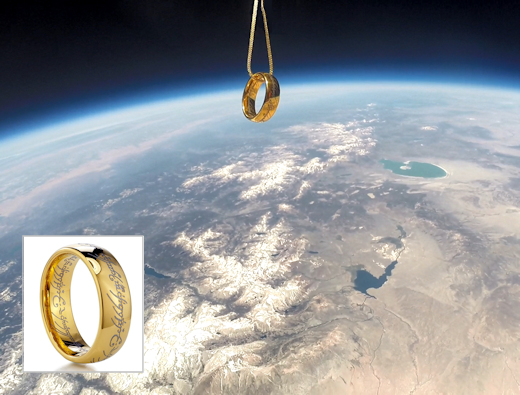
You can have one for $119.95. The students are selling these Tolkien-inspired rings as a fundraiser for their trip. They are made of golden-colored tungsten and inscribed with the authentic Mordor script of the One Ring.
Buy one now, and we will fly it again for you over Hobbiton, located in the North Island of New Zealand where our cosmic ray balloons will be released. Just note "Please fly it again!" in the comments section at checkout.
Each golden ring comes with a greeting card showing the ring in flight and telling the story of its journey to the edge of space. Sales support the Earth to Sky Calculus cosmic ray ballooning program and hands-on STEM research.
Far Out Gifts: Earth to Sky Store
All proceeds support hands-on STEM education