SOLAR WIND GRAZES EARTH: A stream of solar wind is grazing Earth's magnetic field today but, so far, it is doing little to excite geomagnetic activity. Winter darkness might allow photographers of the southern hemisphere to photograph the aurora australis at high latitudes. Otherwise, this appears to be a negligible space weather event. Free: Aurora Alerts.
MYSTERIOUS TWINNED RAINBOW: Scientists have studied rainbows for hundreds of years. Isaac Newton himself applied his intellect to understanding the physics of the colorful arcs. Yet after all these years, there is one rainbow scientists do not fully understand--the "twinned bow." Jan Curtis photographed this specimen on June 21st from Cheyenne, Wyoming:
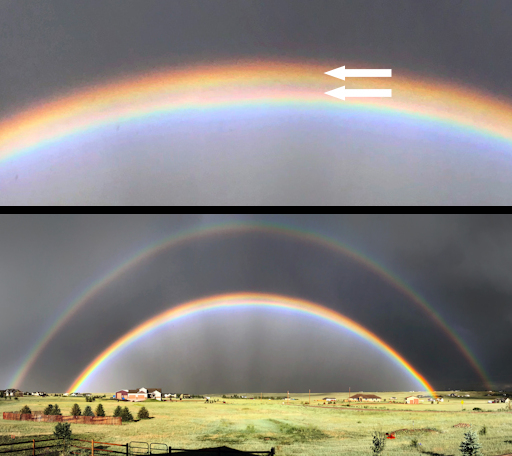
"This rare 'twinned rainbow' was perhaps the brightest rainbow I've ever seen," says Curtis. "It followed on the tails of a extremely severe thunderstorm that fortunately passed just a few miles to my north."
"Several twinned bows have been imaged, mostly during heavy showers, but currently there is no agreed explanation for them," says atmospheric optics expert Les Cowley. "They might form from a mixture of water drops and ice spheres." Indeed, Curtis reports intense hail around the time of his sighting.
"A stronger possibility is that non-spherical raindrops produce one or both bows," Cowley adds. "Surface tension forces keep small raindrops fiercely spherical but as they fall large drops are flattened by air resistance or might even oscillate between flattened and elongated spheroids."
Another striking aspect of Curtis's image is the overall double structure of the rainbow--one rainbow on the inside, another on the outside. Not to be confusd with twinned rainbows, double rainbows are often seen and well understood. The splitting of the inner bow into twins added a dash of mystery to this otherwise common occurance.
Realtime Space Weather Photo Gallery
A SPRITE SEEN FROM 35,000 FEET: Pilot Brian Whittaker has spent thousands of hours flying back and forth to London from the USA, and he has seen countless wonders of the night sky through the glass of the cockpit. This week for the first time, he photographed a sprite:
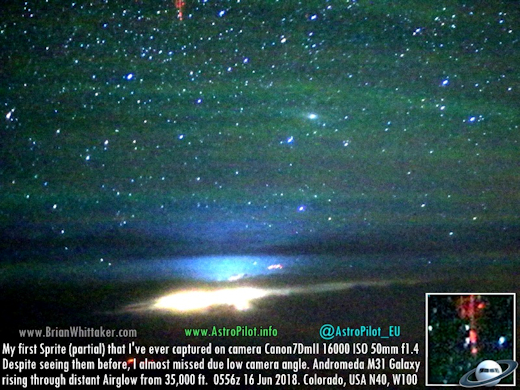
"I was very excited to finally photograph a sprite on the American Plains!" says Whittaker. "On June 16th, I was flying from Las Vegas to London when we flew by several very active thunderclouds. I had a prolonged view of countless rapid lightning flashes. This sprite leaped up from one of the thunderclouds."
The green bands in Whittaker's image are not auroras, but rather airglow. Airglow is caused by an assortment of chemical reactions in Earth's upper atmosphere. These reactions get started during daylight hours when the atmosphere is bathed in strong UV radiation from the sun. Sometimes, on dark nights, the green afterglow is visible, colored green by oxygen atoms 90-100 km high. Airglow occurs just above the altitude of most sprites.
"Sprites are really high up!" says Whittaker. "I wonder how many earlier sprites I've missed over the years because my camera was set just a little too low?"
Indeed. Summer is the season for sprites, and a good time for photographers to point their optics high over the tops of towering thunderheads. Here's how.

ONE RING TO RULE THE STRATOSPHERE: Today, the students of Earth to Sky Calculus are in New Zealand preparing to launch a trio of cosmic ray balloons over Earth's 8th continent. But first... on June 12th they launched a ring of power to the stratosphere. Here it is floating 33 km above the Sierra Nevada mountains of central California:
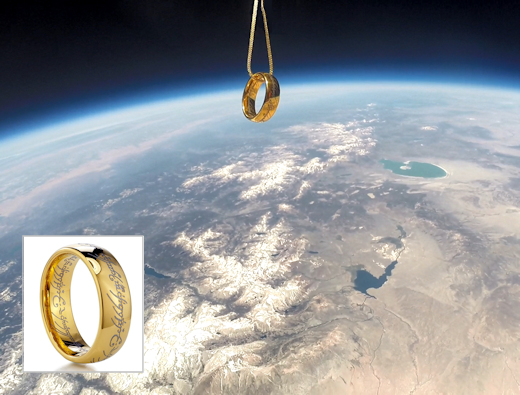
You can have one for $119.95. The students are selling these Tolkien-inspired rings as a fundraiser for their trip. They are made of golden-colored tungsten and inscribed with the authentic Mordor script of the One Ring.
Buy one now, and we will fly it again for you over Hobbiton, located in the North Island of New Zealand where our cosmic ray balloons will be released. Just note "Please fly it again!" in the comments section at checkout.
Each golden ring comes with a greeting card showing the ring in flight and telling the story of its journey to the edge of space. Sales support the Earth to Sky Calculus cosmic ray ballooning program and hands-on STEM research.
Far Out Gifts: Earth to Sky Store
All proceeds support hands-on STEM education