SOLAR WIND TO GRAZE EARTH: A minor stream of solar wind might brush Earth's magnetic field on July 2nd or 3rd. The gaseous material is flowing from a weakly-organized hole in the sun's atmosphere. The encounter could spark auroras at high latitudes, best seen in the southern hemisphere where winter darkness favors visibility. Free: Aurora Alerts.

THE MOON VISITS MARS. WHAT'S NEXT? Last night, the Moon passed by Mars in the constellation Capricornus. "The red color of Mars was very apparent even in the nearly full Moon's illumination," reports Eliot Herman, who photographed the conjunction from Tucson, Arizona:

"It was a great view," he says.
Now the Moon is moving away from Mars. Next up: Mercury and Venus. On July 14th, an exquisitely slender crescent Moon will pass by Mercury deep in the glow of sunset. One night later, the Moon will have a spectacular encounter with Venus high in the twilight sky. Mark your calendar for that. Sky maps: July 14, 15.


Realtime Space Weather Photo Gallery
SPACEX MAKES A NOCTILUCENT CLOUD: NASA's AIM spacecraft is monitoring a veritable explosion of natural noctilucent clouds (NLCs) around the Arctic Circle. Yesterday, June 29th, SpaceX created an NLC of its own by launching a rocket over Florida. Mike Deep photographed the jellyfish-shaped cloud from the roof of the Vehicle Assembly Building at Kennedy Space Center:


"SpaceX launched a Falcon 9 rocket carrying supplies to the ISS," explains Deep. "The liftoff time was pre-dawn at 5:42am, which meant the rocket lifted off in darkness and ascended into sunlight at extreme altitude, resulting in noctilucent clouds and a jellyfish plume from the second stage."
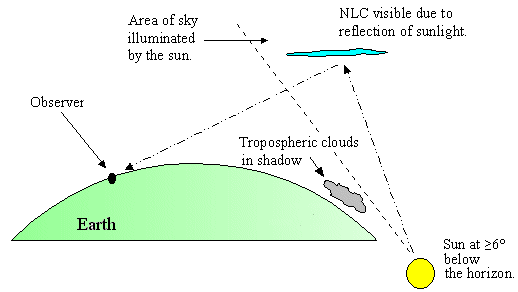
Natural noctilucent clouds form when summertime wisps of water vapor rise to the top of Earth's atmosphere and crystallize around specks of meteor smoke. Mesospheric winds gather the resulting ice crystals into rippling clouds of electric-blue around the Arctic Circle.
Manmade noctilucent clouds, on the other hand, can form from ice crystals in a rocket's exhaust. These crystals can catch the rays of the distant rising sun, producing luminous forms in the dark pre-dawn sky. Sample photos may be found here, here and here.
SpaceX's noctilucent cloud was fleeting. It's gone now. But the natural variety may still be seen from high-latitude locations in Europe and Canada. Observing tips: Look west 30 to 60 minutes after sunset when the sun has dipped well below the horizon. If you see luminous blue-white tendrils spreading across the sky, you may have spotted a noctilucent cloud.
Realtime Noctilucent Cloud Photo Gallery
ONE RING TO RULE THE STRATOSPHERE: This week, the students of Earth to Sky Calculus are in New Zealand launching cosmic ray balloons over Earth's 8th continent. To pay for the helium, they launched a ring of power to the stratosphere. Here it is floating 33 km above the Sierra Nevada mountains of central California:

You can have one for $119.95. The students are selling these rings as a fundraiser for their trip. They are made of golden-colored tungsten and inscribed with the authentic Mordor script of the One Ring.
Buy one now, and we will fly it again for you over Hobbiton, located in the North Island of New Zealand where our cosmic ray balloons will be released. Just note "Please fly it again!" in the comments section at checkout.
Each golden ring comes with a greeting card showing the ring in flight and telling the story of its journey to the edge of space. Sales support the Earth to Sky Calculus cosmic ray ballooning program and hands-on STEM research.
Far Out Gifts: Earth to Sky Store
All proceeds support hands-on STEM education