SOLAR MINIMUM IS COMING: For the 5th day in a row and the 92nd day so far in 2018, the sun is blank--no sunspots. The featureless solar disk is a sign that Solar Minimum is coming. Indeed, it appears to be approaching even faster than forecasters predicted. How does this affect us? Ironically, weak solar activity boosts cosmic radiation in Earth's atmosphere--a situation that is expected to worsen in the years ahead. Free: Aurora Alerts.

DUST STORM SWALLOWS MARS: A martian dust storm that started in late May, silencing NASA's Opportunity rover, has now wrapped itself around the entirety of Mars, transforming the appearance of the Red Planet. "Mars has essentially vanished beneath the dust," says longtime Mars photographer Damian Peach of the UK. He created this animation showing how much has changed:
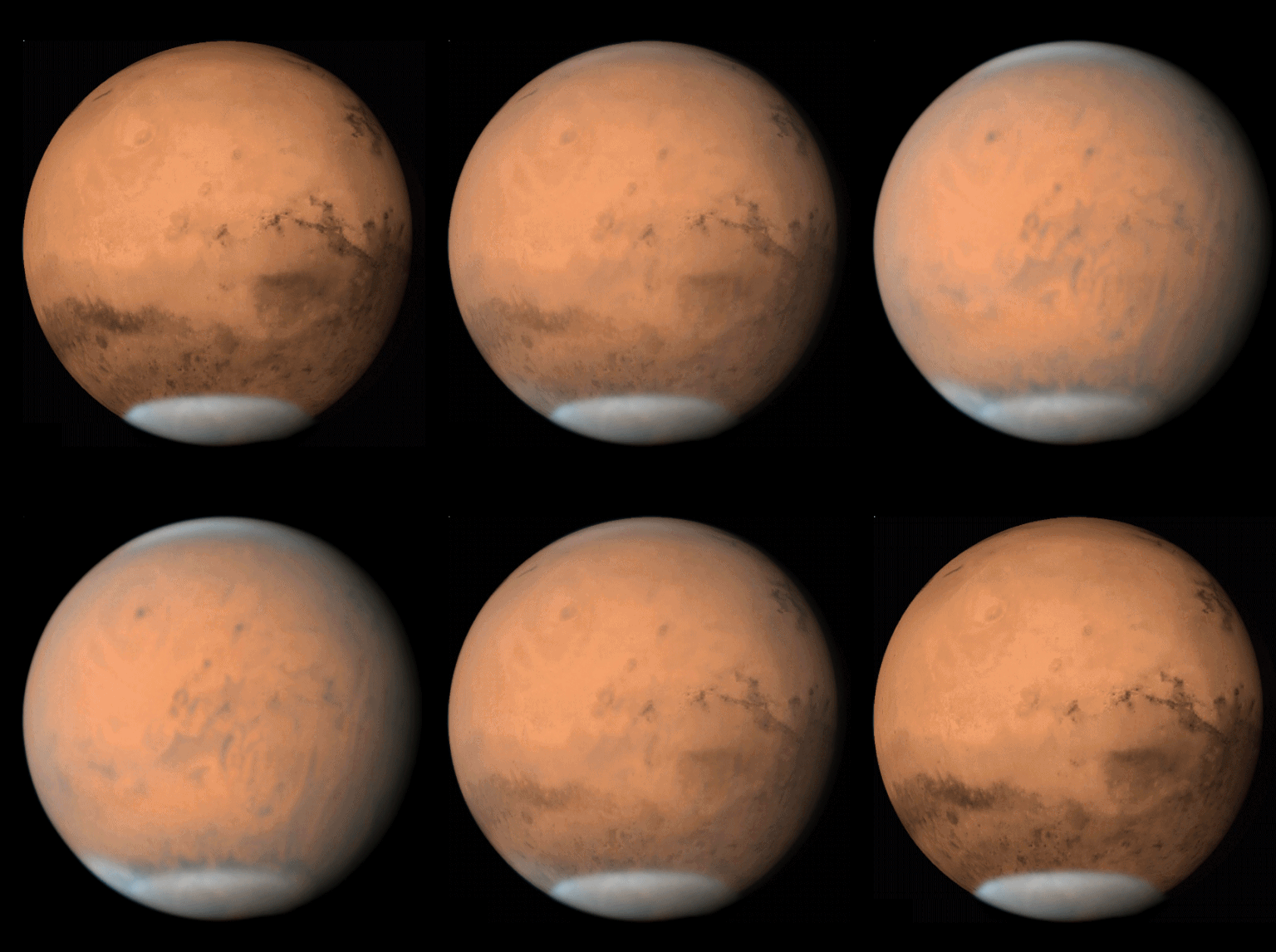
"The animation shifts back and forth between a reference image of the Tharsis region taken by the Mars Global Surveyor spacecraft and my own image taken on June 28th," he explains. "The volcanic peaks of Tharsis remain clear, and also a dark spot in Valles Marineris, but little else matches known albedo markings, especially the dark/light streaks."
In Rome, Italy, amateur astronomer Raffaello Lena has also been monitoring Mars. In this image he compares a picture he took in June 2016 with one taken just yesterday:
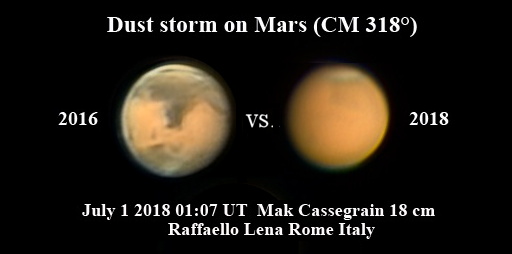
"Although the same side of Mars was facing us in both images, the planet looks totally different," he says. "Dust is hiding all of the usual surface markings."
Even naked-eye observers can see the effects of the storm. Mars is shining brightly the constellation Capricornus, easy to see at midnight. The planet's usual sharp burnt-orange color has been replaced by a wan salmon hue characteristic of dust. [sky map]

Mars is approaching Earth for a 15-year close encounter in late July. Astronomers have had this month marked on their calendars for years, expecting unusually clear views of the Red Planet. Martian dust may have other ideas. Stay tuned for updates.
Realtime Space Weather Photo Gallery
TRANS-PACIFIC SPACE WEATHER BALLOON LAUNCH: No one has ever done this before. On June 23rd, Spaceweather.com and the students of Earth to Sky Calculus launched two space weather balloons separated by the entire Pacific Ocean. One balloon was released from Kawhia, New Zealand; the other from Bishop, California, more than 10,800 km away. These GPS pushpins show the balloons in flight:

The purpose of the unprecedented double launch was to measure cosmic rays in the atmosphere--specifically, to find out how they differ on opposite sides of the Pacific. We have been traveling around the globe for the past two years, mapping Earth's planetary radiation field with sensors carried aloft by helium balloons. New Zealand is now part of our monitoring network.
Launching balloons around the world runs up a big helium bill. To help pay it, the California team launched this iridescent crystal pyramid to the stratosphere:

You can have it for $149.95. The students are selling this pyramid and several others like it to fund the Earth to Sky ballooning program. Each one comes with a greeting card showing the pyramid in flight and telling the story of its journey to the edge of space. All sales support hands-on STEM research.
Far Out Gifts: Earth to Sky Store
All proceeds support hands-on STEM education