SOLAR MINIMUM IS COMING: For the 6th day in a row and the 93rd day so far in 2018, the sun is blank--no sunspots. The featureless solar disk is a sign that Solar Minimum is coming. Indeed, it appears to be approaching even faster than forecasters predicted. How does this affect us? Ironically, weak solar activity boosts cosmic radiation in Earth's atmosphere--a situation that is expected to worsen in the years ahead. Free: Aurora Alerts.

FIREWORKS ON THE SUN: The face of the sun may be devoid of spots, but the edge of the sun is brimming with activity. "While folks in the USA are getting ready to celebrate the 4th of July with fireworks and BBQs, our sun is displaying some fireworks of its own in the form of a nice prominence," reports Bill Burnett, who sends this picture from Hamilton, Montana:

"The prominence is located on the NW edge of the sun," he says. "I photographed it using an 80mm ED Refractor equipped with an H-alpha filter--a type of safe filter tuned to the red glow of solar hydrogen."
Prominences are, essentially, clouds of hot plasma held above the sun's surface by magnetic fields. They are most photogenic when they appear near the edge of the sun, allowing them to be photographed against of the canvas of black space beyond. This prominence is more than 50,000 km tall and at least three times as wide--dimensions that make it an easy target for backyard solar telescopes. If you have one, take a look!
Realtime Space Weather Photo Gallery
TRANS-PACIFIC SPACE WEATHER BALLOON LAUNCH: No one has ever done this before. On June 23rd, Spaceweather.com and the students of Earth to Sky Calculus launched two space weather balloons separated by the entire Pacific Ocean. One balloon was released from Kawhia, New Zealand; the other from Bishop, California, more than 10,800 km away. These GPS pushpins show the balloons in flight:

The purpose of the unprecedented double launch was to measure cosmic rays in the atmosphere--specifically, to find out how they differ on opposite sides of the Pacific. We have been traveling around the globe for the past two years, mapping Earth's planetary radiation field with sensors carried aloft by helium balloons. New Zealand is now part of our monitoring network.
Launching balloons around the world runs up a big helium bill. To help pay it, the California team launched this iridescent crystal pyramid to the stratosphere:
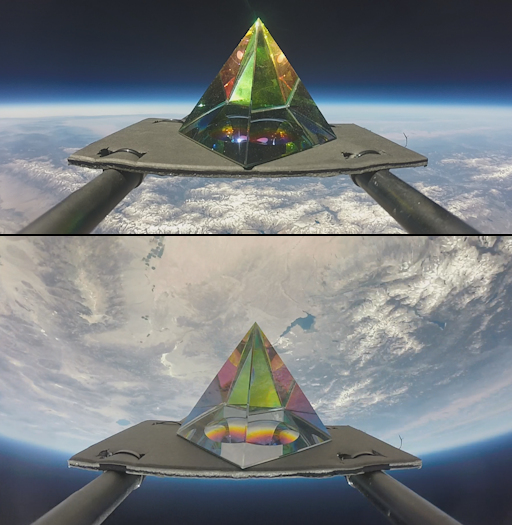
You can have it for $149.95. The students are selling this pyramid and several others like it to fund the Earth to Sky ballooning program. Each one comes with a greeting card showing the pyramid in flight and telling the story of its journey to the edge of space. All sales support hands-on STEM research.
Far Out Gifts: Earth to Sky Store
All proceeds support hands-on STEM education