MORE THAN A WEEK WITHOUT SUNSPOTS: The sun has been without sunspots for 8 consecutive days. Consider this the shape of things to come. The sun is rapidly plunging into a deep solar minimum. By the end of 2018, spotless intervals will be measured in weeks, not days, as the solar cycle continues to weaken. How does this affect us? Ironically, weak solar activity boosts cosmic radiation in Earth's atmosphere--a situation that is expected to worsen in the years ahead. Free: Aurora Alerts.
SPACE PLANE BUZZES ARCTURUS: Did you know that the US Air Force is flying a space plane around Earth? The secretive X-37B spacecraft, which looks like a miniature version of NASA's old space shuttle, has been in orbit since September 2017 when it launched from Cape Canaveral onboard a SpaceX Falcon 9 rocket. Last night, Kevin Fetter of Brockville, Ontario, video recorded the X-37B flying past the bright star Arcturus:
"The space plane was about as bright as a 4th magnitude star--definitely visible to the unaided eye," says Fetter. "Back in April, I watched it pass across the Moon. Very cool to see!"
The X-37B is on a classified mission, and its orbit has not been published by the US government. Nevertheless, we know where it is. Fetter and other satellite observers have spotted the spacecraft many times, allowing its orbit to be calculated. This means you can see it, too. Flyby predictions are published by Heavens Above, where the space plane is listed as "OTV 5 (USA 277)."
Realtime Space Weather Photo Gallery
APPROACHING GREEN COMET EXPLODES: A comet that could become visible to the naked eye in August has just exploded in brightness. Amateur astronomer Michael Jäger of Austria reports that Comet PANSTARRS (C/2017 S3) brightened 16-fold during the late hours of July 2nd, abruptly increasing in magnitude from +12 to +9. He took this picture of the comet's expanding green atmosphere shortly after the outburst:

"The gas cloud around the comet's nucleus is about 4 arc minutes wide," says Jäger. That means the comet's atmosphere is 260,000 km in diameter, almost twice as wide as the planet Jupiter. These dimensions make it a relatively easy target for backyard telescopes.
Comet PanSTARRS is falling toward the sun from the Oort cloud, a vast reservoir of fresh comets in the distant outer solar system. It has never visited the inner planets before, and, as a result, no one can say what will happen when its fragile ices are exposed to solar heat as it approaches the sun in August. Previous estimates of the comet's brightness max out at magnitude +4--that is, barely visible to the unaided eye from dark-sky sites. Additional outbursts could boost its visibility even more.
The comet was discovered on Sept. 23, 2017, by the PanSTARRS telescope on the summit of the Haleakalā volcano in Maui. PanSTARRS's primary mission is to detect near-Earth asteroids that threaten our planet. In the process,it sweeps up variable stars, supernovas, and comets like this one. With almost a year of data in hand, astronomers have been able to nail down the comet's orbit. Click on the image to launch an interactive 3D visualization from JPL:

Comet PanSTARRS is approaching the sun on a hyperbolic orbit--a narrow open-ended path that will ultimately fling it back to the outer solar system. At perihelion (closest approach to the sun) on August 15-16, the comet will be inside the orbit of Mercury, blasted by solar radiation at point-blank range. What will happen then? Stay tuned.
TRANS-PACIFIC SPACE WEATHER BALLOON LAUNCH: No one has ever done this before. On June 23rd, Spaceweather.com and the students of Earth to Sky Calculus launched two space weather balloons separated by the entire Pacific Ocean. One balloon was released from Kawhia, New Zealand; the other from Bishop, California, more than 10,800 km away. These GPS pushpins show the balloons in flight:

The purpose of the unprecedented double launch was to measure cosmic rays in the atmosphere--specifically, to find out how they differ on opposite sides of the Pacific. We have been traveling around the globe for the past two years, mapping Earth's planetary radiation field with sensors carried aloft by helium balloons. New Zealand is now part of our monitoring network.
Launching balloons around the world runs up a big helium bill. To help pay it, the California team launched this iridescent crystal pyramid to the stratosphere:
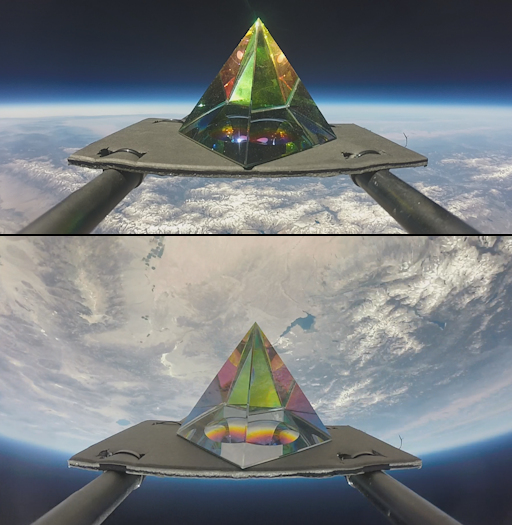
You can have it for $149.95. The students are selling this pyramid and several others like it to fund the Earth to Sky ballooning program. Each one comes with a greeting card showing the pyramid in flight and telling the story of its journey to the edge of space. All sales support hands-on STEM research.
Far Out Gifts: Earth to Sky Store
All proceeds support hands-on STEM education